
Flagship phone season landed hard this year. Apple unveiled the iPhone 18 Pro and iPhone 18 Pro Max on September 9, 2026, built around the new A20 Pro chip. Qualcomm’s Snapdragon 8 Elite Gen 5 already powers a wave of Android flagships since its September 2025 debut, from the Galaxy S26 to the Xiaomi 17 series. Both chips now sit at the top of their platforms, and the numbers between them tell a clearer story than most silicon rivalries in recent years.
This isn’t a fair fight in the traditional sense. Apple builds one chip for one phone line a year. Qualcomm builds one chip that ends up in dozens of phones across every price bracket. That difference matters as much as the raw benchmark scores below.
Here’s how the two actually compare, spec for spec and score for score.
A20 Pro vs Snapdragon 8 Elite Gen 5: Quick Spec Comparison
| Spec | Apple A20 Pro | Snapdragon 8 Elite Gen 5 |
|---|---|---|
| Process node | TSMC 2nm | TSMC 3nm (N3P) |
| CPU | 6-core: 2 Super Cores + 4 efficiency cores | 8-core, 3rd-gen Oryon: 2 prime + 6 performance cores |
| Peak clock | Around 4.93GHz (early listings, unconfirmed by Apple) | Up to 4.6GHz (prime cores) |
| GPU | 7-core Apple GPU | Adreno GPU (reportedly Adreno 840) |
| Geekbench 6 single-core | Roughly 4,720-4,770 | Roughly 3,588 |
| Geekbench 6 multi-core | Roughly 12,575-12,990 | Roughly 10,207 |
| Neural engine / NPU | Dual 16-core (32 cores total) | Hexagon NPU |
| Memory bandwidth | +50% vs A19 Pro | LPDDR5X, up to 5.3GHz |
| Announced | September 9, 2026 | September 24, 2025 |
Treat those benchmark rows as directional, not gospel. They come from early Geekbench listings and vendor-published specs, not a controlled head-to-head test on identical software.
Why Apple’s Jump to 2nm Actually Matters
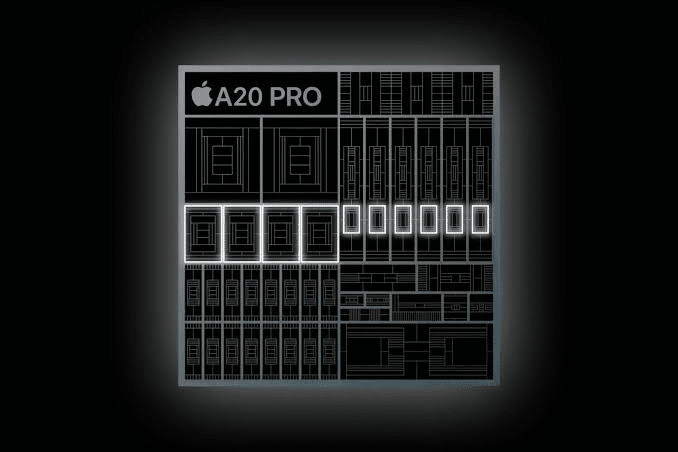
Process node sits at the top of that table for a reason: everything else the A20 Pro does traces back to it. It’s the first 2-nanometer chip in any iPhone, built on TSMC’s most advanced node available. Snapdragon 8 Elite Gen 5 is still on 3nm (N3P), the same broad process family Qualcomm has used since 2023’s Snapdragon 8 Gen 3. That’s an unusually wide gap. Apple and Qualcomm typically sit one node apart at most; this year Apple jumped two.

A smaller node packs more transistors into the same space. Apple says the A20 Pro’s process delivers roughly 15 percent higher transistor density than its predecessor. In practice, that shows up as performance per watt, not just raw speed. It’s part of why Apple could push clock speeds higher while also redesigning the iPhone 18 Pro’s internal cooling around a wider vapor chamber.
Qualcomm isn’t standing still on efficiency either. It claims a 35 percent CPU power efficiency gain and up to 16 percent better overall efficiency for the Snapdragon 8 Elite Gen 5, translating, by its own math, to roughly an extra 1 hour 48 minutes of gaming battery life. But tuning a mature node is a different lever than a full generational jump. That’s the real trade-off here: Qualcomm ships to more devices sooner, Apple ships to fewer devices with a manufacturing edge.
CPU Performance: A20 Pro’s Single-Core Lead Is Real

Early Geekbench 6 listings for the iPhone 18 Pro and Pro Max, spotted within a day of Apple’s keynote, put the A20 Pro at roughly 4,720 to 4,770 single-core and 12,575 to 12,990 multi-core, depending on the exact model and listing. Apple never publishes raw benchmark scores itself, so these numbers aren’t official. Multiple outlets independently landed on similar figures within hours of each other, though, which is a stronger signal than a single leak.
Snapdragon 8 Elite Gen 5’s tested Geekbench 6 scores land closer to 3,588 single-core and 10,207 multi-core. That’s a meaningful single-core gap, large enough on paper to matter for things like app launches and camera processing, where single-thread speed dominates.
Two design philosophies explain it. Apple’s six-core layout leans on two very fast Super Cores backed by four efficiency cores, chasing peak single-thread speed. Qualcomm’s eight-core Oryon layout spreads work across two prime cores and six performance cores, chasing sustained multi-threaded throughput for background AI tasks and heavy multitasking. Neither approach is wrong. If the benchmarks hold up in daily use, Apple currently wins on raw responsiveness, while Qualcomm’s extra cores give it more headroom for running several demanding apps at once.
Last year’s numbers put this gain in context. The A19 Pro scored around 3,800 single-core and 10,000 multi-core in Geekbench 6, so the A20 Pro’s roughly 21 to 25 percent single-core and 27 to 28 percent multi-core gains aren’t small for one generation.
GPU and Gaming: Adreno’s Muscle vs Apple’s Efficiency

That single-core story doesn’t repeat cleanly on the graphics side. Apple’s 7-core GPU in the A20 Pro runs up to 40 percent faster than the A19 Pro’s, by Apple’s own keynote claims, fed by 50 percent more memory bandwidth than before.
Qualcomm claims its Adreno GPU gained 23 percent raw performance and 25 percent in ray tracing over the previous Snapdragon 8 Elite. Early tests on prototype Snapdragon 8 Elite Gen 5 hardware showed it comfortably outrunning the prior-generation Apple chip in GFXBench and 3DMark Wild Life. That testing came with a caveat, though: prototype platforms tend to run a little hotter and faster than what actually ships in retail phones.

The caveat turned out to matter. Separate benchmark testing on retail-class Snapdragon 8 Elite Gen 5 hardware found sustained CPU performance dropping to around 58 percent of peak under extended load, a sign that thermal management, not raw silicon, is the chip’s real weak point. That’s not something a three-minute benchmark run catches. It’s something a 45-minute gaming session does.
Neural Engine vs Hexagon NPU: The On-Device AI Race
Apple doubled the A20 Pro’s Neural Engine to 32 total cores, two 16-core blocks, claiming twice the AI compute of the A19 Pro and 2x faster 8-bit floating-point math. The target is running larger language models directly on the phone instead of routing them to the cloud.
Qualcomm’s answer is a Hexagon NPU it says runs 37 percent faster than the previous generation, paired with an upgraded Sensing Hub built for agentic AI assistants, ones that can act on a phone’s behalf rather than just answer questions.
Both companies are chasing the same problem from different directions. Apple is throwing more dedicated silicon at its Neural Engine. Qualcomm is layering smarter, always-on sensing around a faster NPU. Whether either company’s AI claims mean much day to day depends entirely on which apps and OS features end up actually using them, and most of those are still rolling out.
Memory, Modem, and What Else Changed
The A20 Pro’s memory story goes beyond bandwidth. Apple switched to a new packaging design, called Wafer-Level Multi-Chip Module, that places RAM beside the processor die instead of stacking it on top. That keeps memory out of the direct thermal path, and it’s part of why Apple can claim sustained performance holds up better under load. Apple also paired the chip with its own new N1 wireless chip (Wi-Fi 7, Bluetooth 6, Thread) and a C2 modem it says uses 15 percent less energy than the previous C1X.
Snapdragon 8 Elite Gen 5 pairs with LPDDR5X memory running up to 5.3GHz and UFS 4.1 storage, plus Qualcomm’s own Snapdragon X85 5G modem and Wi-Fi 7/Bluetooth 6.0. None of that is a dramatic leap over last year, but it’s a proven combination already shipping in real phones today.
Which Phones You Can Actually Buy Each Chip In
Here’s the part spec sheets skip: availability. The A20 Pro exists in exactly two phones right now, the iPhone 18 Pro and iPhone 18 Pro Max, with preorders opening September 12 and phones shipping September 18, 2026.
Snapdragon 8 Elite Gen 5 already reaches far more phones: the OnePlus 15 (the first phone to ship with it), the Xiaomi 17 series, and the Galaxy S26 line, among others. One wrinkle worth knowing: not every Galaxy S26 gets this chip. Samsung still splits the Galaxy S26 lineup between Snapdragon and its own Exynos silicon by region, so the phone’s name alone doesn’t guarantee which processor is inside.
That access gap is the real difference between these two chips, more than any single benchmark number. Apple’s silicon advantage only reaches people willing to pay iPhone 18 Pro prices. Qualcomm’s chip shows up across several price points and nearly every major Android brand outside Samsung’s Exynos markets and Google’s Tensor-powered Pixels.
Final Verdict
On paper, the A20 Pro wins this round. It leads in single-core speed, multi-core speed, and GPU compute, backed by a real manufacturing advantage Qualcomm won’t close until its own next node shift. But “wins the benchmark” and “wins your money” aren’t the same question. Snapdragon 8 Elite Gen 5 already powers phones across a wide price range from a dozen different brands, while the A20 Pro lives in exactly one phone line.
Which chip actually serves you better depends less on the numbers above and more on which ecosystem you’re already standing in.
Don’t miss these related reads: