The iPhone 18 Pro ships today, September 18, 2026, and the first Geekbench listings for its A20 Pro chip are already circulating. That timing puts Apple’s newest silicon right next to MediaTek’s Dimensity 9500, the chip that spent the last year proving MediaTek could finally trade blows with Apple at the top end. A year ago, the Dimensity 9500 launched and matched the previous-generation A19 Pro almost point for point in Geekbench. The A20 Pro’s jump to a 2nm process just reopened that gap, and by a wide margin.
Neither chip will ever power the same phone, since one runs iOS and the other runs Android. But comparing them tells you something real: how far ahead Apple’s silicon is right now, and what MediaTek would need to close the distance again.
The Numbers at a Glance
- Apple A20 Pro: TSMC 2nm (N2), 6-core CPU (2 performance + 4 efficiency), 7-core GPU, ships in iPhone 18 Pro, iPhone 18 Pro Max, and the foldable iPhone Duo.
- MediaTek Dimensity 9500: TSMC 3nm (N3P), 8-core all-big-core CPU built on Arm’s C1 cores, Arm Mali-G1-Ultra GPU, already shipping in the Oppo Find X9 series since October 2025.
- Process node gap: a full generation. That single fact explains most of what follows.
Why the Process Node Gap Matters
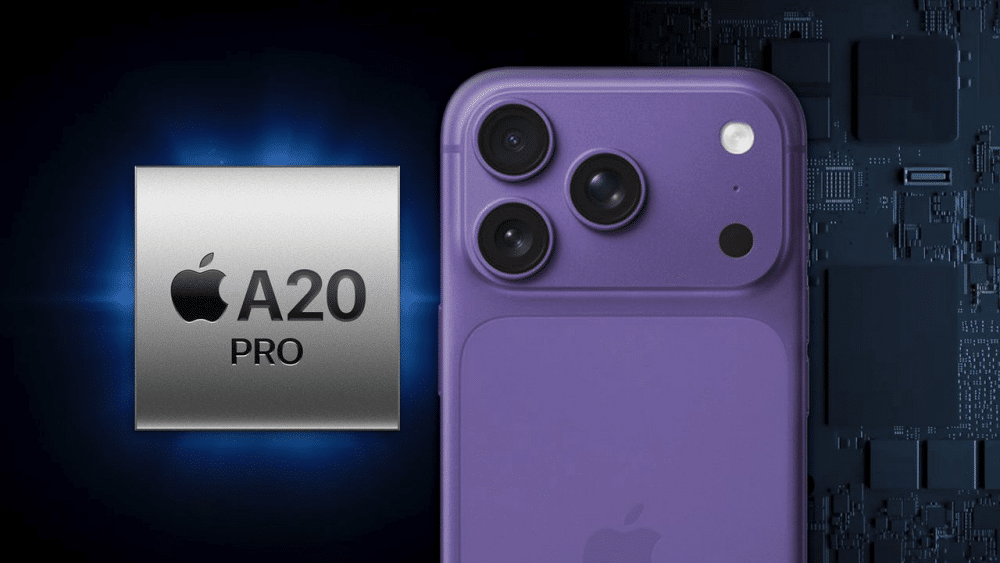
Apple’s A20 Pro is the first 2nm chip to ship inside a phone, built on TSMC’s N2 node. The Dimensity 9500 uses N3P, a refined version of the 3nm node MediaTek has leaned on since the Dimensity 9400. TSMC has said N2 delivers 10% to 15% higher performance at the same power draw as N3E, or 25% to 30% lower power draw at the same performance, along with denser transistor packing.
That’s not a marketing number Apple invented. It’s the foundry’s own claim for the node itself, and it’s the real reason the A20 Pro pulls ahead on efficiency even before you look at core design.
MediaTek isn’t standing still on packaging either. The Dimensity 9500 pairs its 3nm cores with a new Mali-G1-Ultra GPU and a redesigned NPU, which is how MediaTek keeps pace on features even while trailing on the raw node.
CPU Architecture: Two Different Bets

The node explains part of the gap. The core design underneath explains the rest. Apple keeps the split it has used for years: two high-performance cores paired with four efficiency cores, hitting a peak clock of roughly 4.93GHz on the performance cores. It’s a conservative core count that leans on per-core efficiency and Apple’s own microarchitecture rather than raw parallelism.
MediaTek went the opposite direction. The Dimensity 9500 has zero classic low-power efficiency cores. Every one of its eight cores comes from Arm’s new C1 family: one C1-Ultra at 4.21GHz, three C1-Premium cores at 3.5GHz, and four C1-Pro cores at 2.7GHz, each still bigger and more capable than the Cortex-A520-class cores that used to fill that slot. MediaTek started dropping small efficiency cores with the Dimensity 9400 in 2024, betting that a “smaller big core” beats a “true little core” for both battery life and burst performance. Two years in, it’s still the only major flagship SoC line built this way.
Benchmarks: Where the Sources Disagree
This is where a fair comparison gets messy, and it’s worth saying plainly rather than picking one number and moving on.
Early A20 Pro listings put single-core Geekbench scores between roughly 4,006 and 4,725, and multi-core between 11,460 and 12,677, depending on which outlet and which test unit you check. Apple doesn’t publish these figures itself, so every number here comes from pre-retail benchmark leaks rather than an official spec sheet. Adding to the confusion, some outlets label the same scores “Geekbench 6” while others call them “Geekbench 7,” which launched just two months earlier, in July 2026. That version mismatch matters, since Geekbench 7 uses a different scoring baseline than Geekbench 6. Treat any of these early A20 Pro numbers as directionally accurate rather than exact until retail units get properly tested.
The Dimensity 9500 has a cleaner track record, since it’s been out for a year. At its official announcement, MediaTek quoted a Geekbench 6 score of 4,007 single-core and 11,217 multi-core, which it noted matched the A19 Pro at the time. Independent testing on retail Oppo Find X9 units later came in lower, closer to 3,300 to 3,350 single-core and 9,900 to 10,400 multi-core, likely due to thermal and software differences between reference and retail hardware. On AnTuTu v11, the Dimensity 9500 lands between 3.3 million and 3.76 million depending on the device, while an early iPhone 18 Pro Max unit scored 3,551,073, in the same range but not a clean win either way.
Put the two chips’ best-attested numbers side by side and the A20 Pro’s single-core lead looks close to 25% to 30%, which lines up with Apple’s own generational claim against the A19 Pro. Multi-core is a smaller gap, since MediaTek’s eight full-size cores partly offset Apple’s per-core advantage.
GPU and Gaming: Ray Tracing vs Efficiency

The same node gap shows up on the graphics side, though each company is chasing a different goal. MediaTek is pitching the Mali-G1-Ultra as a gaming GPU first, with double the ray-tracing cores of the previous generation and official support for Unreal Engine 5.5 titles running at up to 120fps. That’s a real, specific claim aimed squarely at Android gaming phones, not a vague “better graphics” line.
Apple’s 7-core GPU (up from six in the A19 Pro) leans harder on Metal performance and the chip’s integrated Neural Accelerators, with early testing suggesting close to a 38% to 40% jump over the A19 Pro. Apple’s enhanced vapor chamber, part of the new WMCM packaging that replaces the older InFO design, is built specifically to sustain that GPU performance longer under load rather than throttling after a few minutes.
That sustained-performance detail matters more than it sounds. Independent testing on the Dimensity 9500 has shown it dropping to around 59% of peak performance under extended load, a real caveat for anyone buying an Android flagship for long gaming sessions rather than short bursts.
One Chip, Two Different Modem Philosophies
Away from the CPU and GPU cores, the two companies also disagree on where the modem belongs. MediaTek builds its 5G modem directly into the Dimensity 9500 die, supporting sub-6GHz 5G up to 7.4Gbps along with Wi-Fi 7 and Bluetooth 6.0, all in one package. Apple does the opposite.
The iPhone 18 Pro pairs the A20 Pro with a separate chip, Apple’s own C2 modem, continuing the shift away from Qualcomm that started with the C1 in 2025. That’s a real architectural split. MediaTek optimizes around a single chip, while Apple runs the application processor and the modem as two separate roadmaps entirely.
Who Should Care About This Comparison
If you’re deciding between an iPhone 18 Pro and an Android flagship running the Dimensity 9500, like an Oppo Find X9, the chip alone won’t make that decision for you. Both are fast enough that you won’t notice a difference in everyday use: apps open instantly and multitasking doesn’t stutter. Neither chip is the bottleneck in your day-to-day use.
Here’s where it matters. Heavy mobile gamers on Android should factor in the Dimensity 9500’s thermal throttling under sustained load before buying for that reason specifically. Anyone comparing benchmark screenshots online right now should treat A20 Pro numbers as early and unofficial for at least a few more weeks, until independent reviewers get retail units into controlled testing. For more on how the new chip affects the phone as a whole, see our iPhone 18 Pro vs iPhone 17 Pro upgrade breakdown, and if the foldable is on your radar, the iPhone 18 Pro vs iPhone Duo comparison covers how the same A20 Pro chip behaves in a very different chassis.
For a look at how this cross-platform gap played out last generation, our Apple A19 vs Google Tensor G5 benchmark comparison covers the same territory from the other side of the Android divide, and MediaTek’s own Dimensity 9500 announcement is worth reading directly if you want the unfiltered version of its performance claims.
Final Thoughts
The A20 Pro’s 2nm process gives Apple a real, measurable lead over the Dimensity 9500 right now, and it’s the kind of lead a node advantage typically buys: better single-core scores, better sustained performance, and a GPU that holds its numbers longer under load. MediaTek isn’t behind because its engineering got worse.
The Dimensity 9500 matched a flagship Apple chip a year ago on an older node, which is still a genuine achievement.
The real story isn’t which chip wins today. It’s whether MediaTek’s next flagship closes a 2nm gap the way it closed the architecture gap before it.