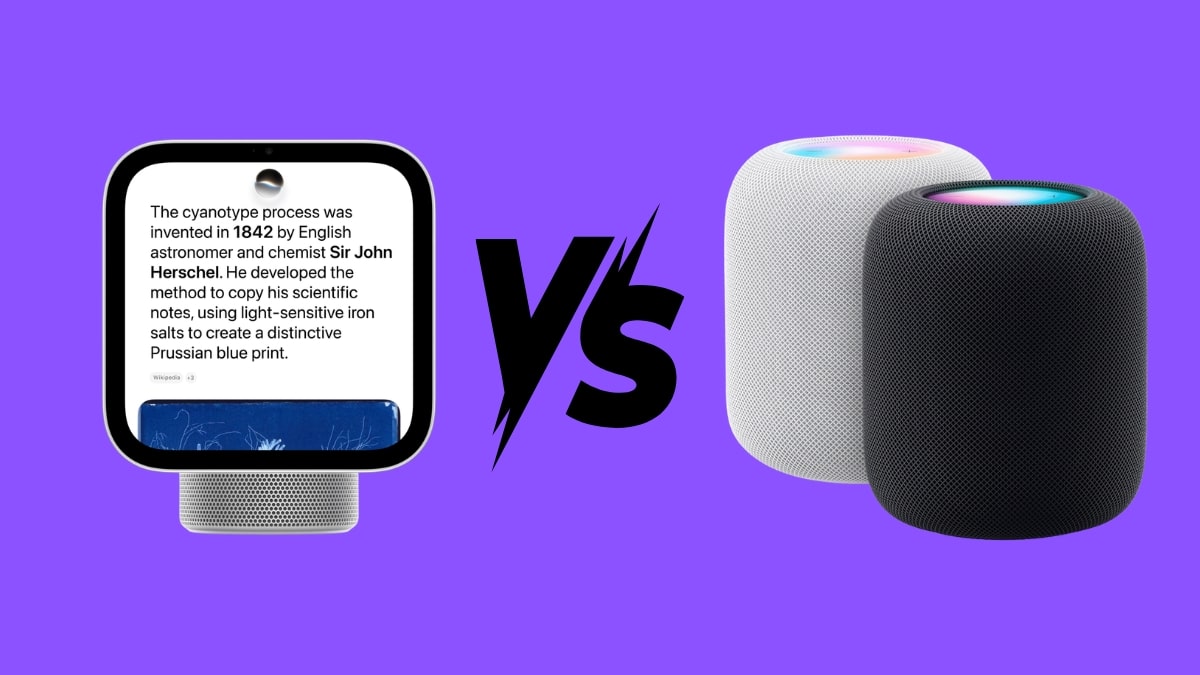
You want a smarter Siri in your kitchen, and Apple now sells two answers at roughly the same price. They solve different problems. One is a screen that listens and talks back. The other is a speaker built for music that, for now, still runs the old Siri.
Apple announced HomeView on October 13, 2026, alongside a new HomePod mini and Apple TV 4K. It’s Apple’s first smart display: $299, pre-orders open now, deliveries from November 13. The full-size HomePod (2nd generation) arrived in February 2023 and now costs $349.
Here’s what actually separates them, and which one fits your home.
HomeView vs HomePod: Key Specs Side by Side
| Apple HomeView | HomePod (2nd generation) | |
|---|---|---|
| US price | $299 (tabletop or wall-mounted) | $349 |
| Released | November 13, 2026 | February 3, 2023 |
| Display | 7-inch Liquid Retina, True Tone, 500 nits | None |
| Chip | A18 | S7 |
| Audio | 2 full-range drivers, down-firing woofer, 2 passive radiators (tabletop) | 4-inch high-excursion woofer, 5 horn-loaded tweeters |
| Camera | Center Stage camera for FaceTime | None |
| Siri AI | Yes (beta) | Not announced |
| Stereo pairing | Not mentioned by Apple | Yes |
| Temperature/humidity sensor | Not listed | Yes |
| Thread radio | Not listed | Yes |
| Colors | Silver, starlight, rose pink, space gray (wall model: space gray, silver) | Midnight, white |
The table already hints at the pattern. HomeView adds a screen, a camera, and a newer brain. HomePod keeps the better speaker hardware and a few smart home extras HomeView doesn’t list.
The Screen Costs Less Than the Speaker
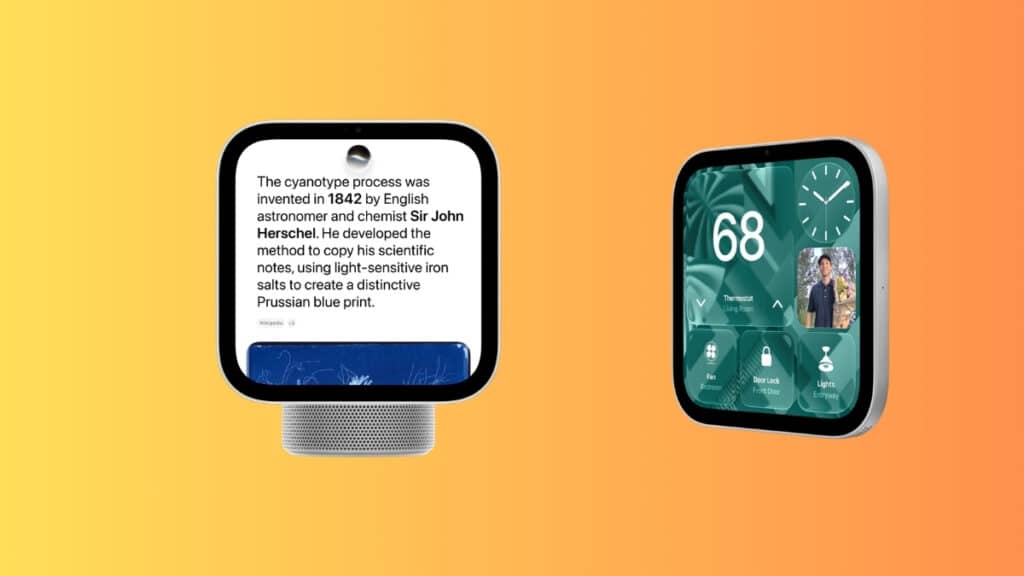
This is the strangest part of Apple’s lineup right now. On June 25, 2026, Apple raised HomePod from $299 to $349, blaming a memory chip shortage. Four months later, it launched a device with a display, a camera, and an A18 chip for $50 less.
One caveat changes the math for the wall-mounted HomeView. It needs a Schneider Home mount, sold separately:
- Power Mount USB-C Wall Connector: $59.95
- Power Mount AC Wired: $79.95
- Power Mount PoE Wired: $129.95 (arrives early 2027)
So a wall-mounted HomeView realistically costs $359 to $429 before installation. The tabletop model is the true $299 option.
What HomeView Actually Does All Day
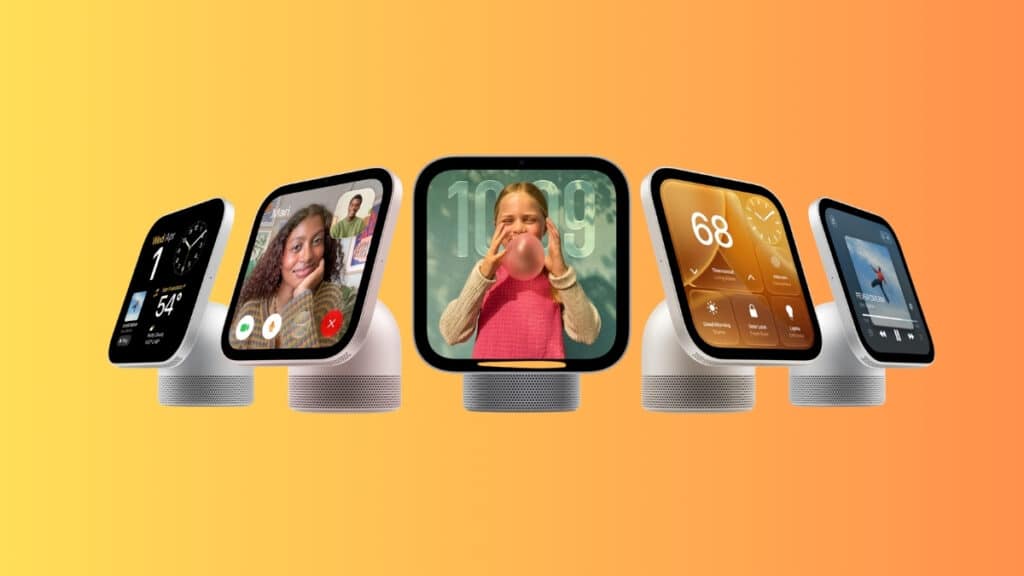
Think of HomeView as a control panel that happens to play music. Apple designed it for glancing and talking, with touch as a backup.
Picture the typical moment: your hands are covered in dough, a timer is running, and someone rings the doorbell. HomeView handles all three. It converts web recipes into step-by-step instructions, runs hands-free timers, and its Home Camera face shows up to nine camera feeds at once.
Other features worth knowing:
- Personal profiles for up to six people. HomeView recognizes each person by face and shows their own Home Screen with apps and widgets.
- FaceTime with Center Stage. The camera keeps you framed as you move around the kitchen.
- Intercom and Find My. Broadcast to one room or the whole house, or locate an iPhone, AirPods case, or something tagged with an AirTag (here are some useful AirTag accessories if you track keys or bags).
- Alarm detection. It listens for smoke and carbon monoxide alarms and alerts your iPhone, iPad, or Apple Watch.
The display also adapts to distance: simpler content from across the room, more detail up close. That’s a small design choice that matters more on a countertop than on a phone.
There’s No App Store, and Your iPhone Fills the Gap
HomeView doesn’t have its own App Store. Instead, it works like CarPlay: third-party apps appear when a paired iPhone or iPad is nearby. Audio apps that already support CarPlay, such as Spotify and Audible, work out of the box.
Personal content has stricter rules. Your Messages, Calendar, and third-party apps appear only when HomeView recognizes your face and your paired iPhone or iPad is present and recently unlocked. Guests still get shared photo albums and music.
Who this frustrates: households where someone uses Android. Setup itself requires a compatible iPhone or iPad running the latest software.
HomePod Still Wins When Music Is the Point
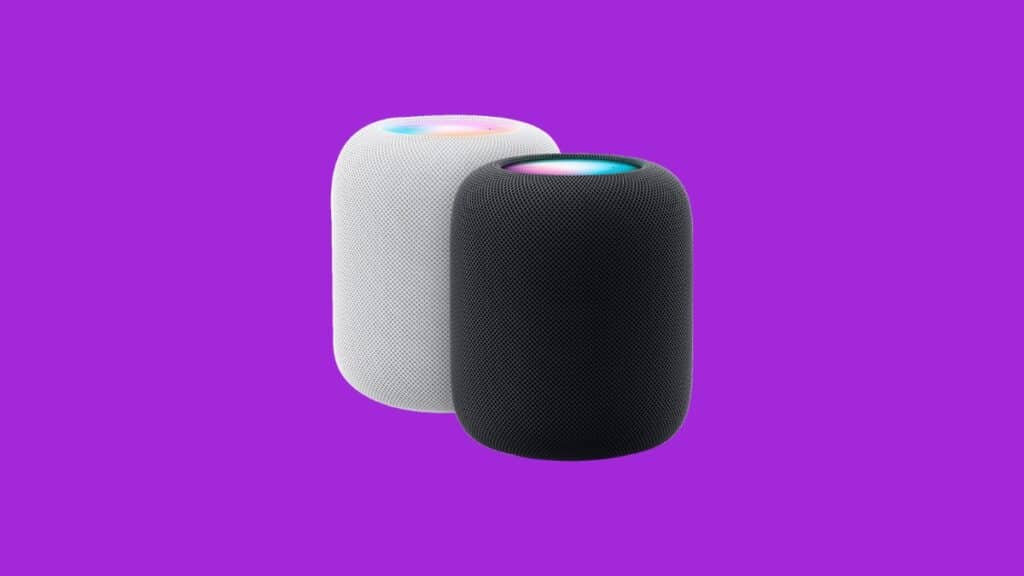
Speaker hardware tells the story. HomePod uses a 4-inch high-excursion woofer and five horn-loaded tweeters, plus an internal calibration mic that corrects bass for your room, according to Apple’s HomePod (2nd generation) specs. HomeView’s tabletop base uses two full-range drivers, a down-firing woofer, and two force-cancelling passive radiators. The wall-mounted model drops to two drivers.
That gap shows up in three practical ways:
- Stereo pairs. Two HomePods pair as left and right channels. Apple’s HomeView announcement mentions multiroom audio with HomePod and AirPlay speakers, but not stereo pairing.
- Home theater. Two HomePods (2nd generation) or two new HomePod mini speakers work as a four-speaker surround setup with the new Apple TV 4K.
- Sensors. HomePod has temperature and humidity sensors that can trigger automations, like switching on a fan when a room gets warm. HomeView’s announcement doesn’t list them.
If you mainly play music in a living room, HomeView’s screen adds little. HomePod’s speaker adds a lot.
Siri AI Is the Real Dividing Line
Here’s where the newer device pulls ahead. HomeView ships with Siri AI, Apple’s rebuilt assistant with broader knowledge, more natural conversation, and onscreen awareness. It’s still labeled beta in HomeView software 27.2, and it supports English in the US, UK, Australia, Canada, India, New Zealand, Singapore, and South Africa.
Your iPhone decides how smart it gets. With an Apple Intelligence-enabled iPhone or iPad, HomeView can pull personal context from Messages, Calendar, and Apple Music. Without one, you get world knowledge and music discovery only. Custom expressive Siri voices go further and require an iPhone 17 Pro, iPhone 18 Pro, iPhone Air, or an M4 iPad with at least 12GB of memory (see our iPhone 18 Pro vs iPhone 17 Pro comparison if you’re weighing that upgrade).
HomePod (2nd generation) is the open question. Apple hasn’t announced Siri AI for it. Code found in HomePod Software 27 suggests Siri AI may require new hardware, and MacRumors doesn’t expect a new full-size HomePod before the end of 2026. Apple did confirm Siri AI for the new HomePod mini ($149) through a future software update.
Buying a $349 HomePod today means buying the old Siri, with no confirmed path to the new one.
Smart Home Hub Support: One Gap to Check
Both devices work as Apple Home hubs. Apple’s new Home Collection (cameras, thermostats, and a lock built with LG and Schneider Electric, arriving from December 2026) needs a hub such as HomeView, HomePod, or Apple TV.
The detail to verify is Thread. Apple’s spec page lists Thread networking for HomePod (2nd generation). Apple’s HomeView announcement doesn’t mention Thread at all. If your home runs on Thread accessories, keep your current HomePod, HomePod mini, or Apple TV as the border router until Apple publishes full HomeView specs.
A Camera in Your Kitchen: How HomeView Handles Privacy
HomePod has no camera, so this question only applies to HomeView. Apple says the A18 chip processes camera and microphone data inside Secure Exclaves, isolated from HomeView’s software, apps, and Apple itself. Siri requests run on-device or through Private Cloud Compute.
One footnote is worth reading. Apple notes that personal information may remain accessible under certain conditions even when your paired iPhone is off Wi-Fi, such as when your face is recognized and the phone was recently unlocked nearby. For a bedroom or a home office, a camera-free HomePod is the simpler choice.
Which One Should You Buy?
Your main use decides it:
- Buy HomeView if you control lights, locks, and cameras daily, cook with recipes, make FaceTime calls, and want Siri AI now. The tabletop model at $299 is the better value.
- Buy HomePod if music quality matters most, you want a stereo pair or Apple TV surround, and Siri’s intelligence is secondary.
- Buy the HomePod mini (2nd generation) if you want Siri AI on a budget. It costs $149, arrives October 30, and supports stereo pairing.
- Wait if you want a full-size HomePod with Siri AI, or you live in the EU. Apple isn’t selling HomeView there because Siri AI isn’t available in the region yet.
Plenty of homes will end up with both: a HomeView in the kitchen and HomePods in the living room, linked through multiroom audio.
HomeView Price and Availability in India
HomeView launches in India at Rs 39,900 for both the tabletop and wall-mounted models, with pre-orders open and sales starting November 13. Wall mounts start at Rs 6,900. Siri AI supports English in India from launch, so Indian buyers get the same core experience as US buyers.
Signing Off
HomeView and HomePod overlap less than their prices suggest. HomeView is the better smart home device: a screen, a camera, Siri AI, and a lower starting price. HomePod is the better speaker, but it’s a 2023 product waiting on a successor and a Siri update Apple hasn’t promised.
If you’re choosing one today, let the room decide. Kitchen or entryway, get HomeView. Living room with music on all day, get HomePod, or wait for the next one.