Every time Google launches a new Pixel, the same question comes up: has Tensor finally caught Qualcomm in raw performance? The Pixel 11 series launched on August 12, 2026, with Google’s new Tensor G6, while Qualcomm’s Snapdragon 8 Elite Gen 5 has already spent nearly a year powering flagship Android phones. Based on the specifications and early performance data available so far, Qualcomm still has the advantage for CPU-heavy workloads and gaming.
That gap does not tell the whole story, though. Google has never positioned Tensor as a benchmark-first chip. Tensor G6 focuses heavily on on-device AI, computational photography, security, and tighter integration with Google’s Pixel software. Qualcomm takes a broader approach, prioritizing peak CPU and GPU performance while giving phone makers a powerful AI platform to build on.
Here is how Tensor G6 and Snapdragon 8 Elite Gen 5 compare across performance, gaming, AI, cameras, efficiency, and security.
Tensor G6 vs Snapdragon 8 Elite Gen 5 at a Glance
| Feature | Google Tensor G6 | Snapdragon 8 Elite Gen 5 |
|---|---|---|
| Manufacturer | TSMC | TSMC |
| Process | 3nm | 3nm-class |
| CPU | 7-core reported configuration | 3rd-gen Oryon CPU |
| GPU | PowerVR-based GPU, reported | Qualcomm Adreno |
| AI processor | Google TPU | Qualcomm Hexagon NPU |
| AI improvement | 50% more TPU compute vs G5 | 37% faster NPU vs previous gen |
| Security | Titan M3 | Qualcomm security platform |
| Main focus | Pixel AI, camera, security | CPU, gaming, AI performance |
| Key phones | Pixel 11 series | Multiple Android flagships |
Two Chips With Very Different Launch Timelines
Google Tensor G6 debuted with the Pixel 11, Pixel 11 Pro, Pixel 11 Pro XL, and Pixel 11 Pro Fold during Google’s August 12 hardware event, which we covered in our Made by Google 2026 roundup.
Qualcomm announced Snapdragon 8 Elite Gen 5 on September 24, 2025. Qualcomm says its third-generation Oryon CPU delivers up to 20% better performance than its predecessor, while the redesigned Adreno GPU improves graphics performance by 23%. Its Hexagon NPU is rated 37% faster generation over generation.
That timing difference matters when looking at benchmarks. Snapdragon 8 Elite Gen 5 has had considerably more time in retail hardware with mature firmware and game optimization. Tensor G6 has only just launched, so pre-release or early firmware results should not be treated as definitive.
Manufacturing Process: Tensor G6 Is Not a 2nm Chip
This is one of the biggest corrections to the pre-launch Tensor G6 rumors. For months, reports suggested Google would move Tensor G6 to TSMC’s 2nm manufacturing process. After the Pixel 11 launch, however, Google hardware VP Peng Yu-chun said Tensor G6 is manufactured using an upgraded TSMC 3nm process instead.
That puts Tensor G6 much closer to Snapdragon 8 Elite Gen 5 from a manufacturing perspective than early rumors suggested.
It also means any difference in performance or power efficiency cannot simply be explained by Google having access to a more advanced process node. Architecture, core configuration, clocks, cache design, thermal limits, and software optimization all matter.
Google still claims meaningful efficiency improvements. Tensor G6’s upgraded CPU delivers up to 20% better power efficiency than Tensor G5, alongside 25% faster web browsing and 15% quicker app launches.
CPU Performance: Snapdragon Still Has the Advantage
Raw CPU performance remains Qualcomm’s strongest area. Snapdragon 8 Elite Gen 5 uses Qualcomm’s third-generation Oryon CPU architecture. Qualcomm officially claims a 20% generational CPU performance improvement.
Google has not published the same level of detailed core-by-core specifications for Tensor G6. Reports point to a seven-core configuration using newer Arm CPU cores, but I would treat exact core counts and clock speeds as reported specifications until Google provides a complete technical breakdown.
More importantly, Google’s own messaging around Tensor G6 focuses on responsiveness and efficiency rather than flagship benchmark leadership. The company cites 25% faster browsing and 15% faster app launches compared with Tensor G5.
Early leaked benchmarks have suggested Snapdragon 8 Elite Gen 5 still has a substantial advantage, particularly in multi-core workloads. But because Pixel 11 retail testing is only beginning, I would not use leaked Geekbench scores as the final verdict yet.
For everyday tasks such as messaging, browsing, social media, photography, and switching between normal apps, Tensor G6 should be more than fast enough. For sustained CPU-heavy workloads, emulation, video processing, and intensive multitasking, Snapdragon remains the safer choice.
GPU and Gaming: Qualcomm Wins Clearly
Gaming is where the gap becomes easier to call. Qualcomm says Snapdragon 8 Elite Gen 5’s new Adreno GPU architecture improves graphics performance by 23% over the previous generation. The platform is built around sustained flagship gaming performance, high-refresh-rate graphics, and more demanding mobile titles.
Tensor G6 appears to use a PowerVR-based GPU, although Google has not published detailed GPU specifications. Reports surrounding the launch suggest Google again prioritized AI and efficiency improvements over building the fastest graphics subsystem possible.
That does not mean Pixel 11 phones cannot game. Popular titles should run perfectly well, especially at reasonable settings. The difference becomes more meaningful with demanding games, high frame-rate targets, emulation, and extended gaming sessions.
If gaming is one of your main reasons for buying a flagship Android phone, Snapdragon 8 Elite Gen 5 is the better chip.
On-Device AI: Tensor G6’s Biggest Strength
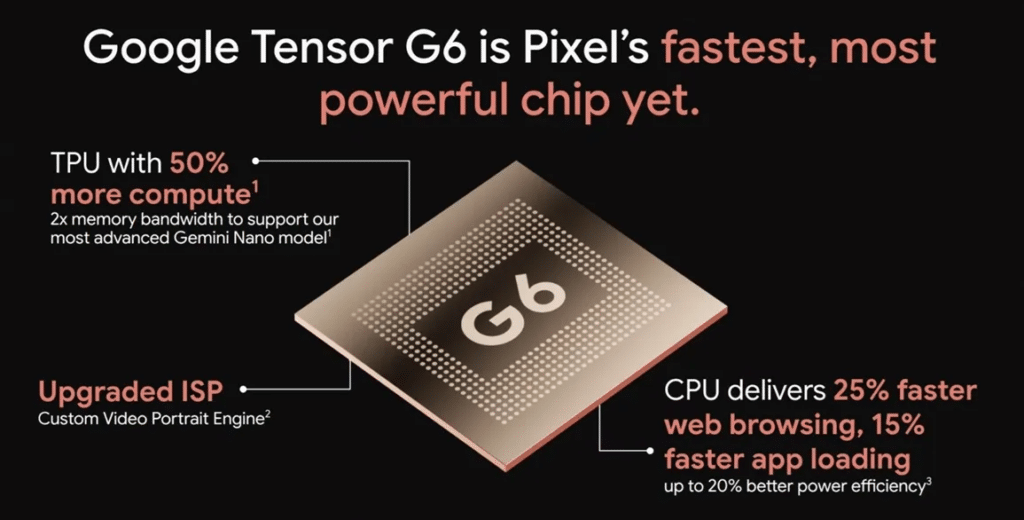
This is where Tensor G6 becomes much more competitive. Google says Tensor G6 includes 50% more TPU compute than Tensor G5. It also supports Google’s latest on-device Gemini Nano model and is designed specifically around the AI workloads Google ships on Pixel phones.
Google’s advantage here is vertical integration. It controls the Tensor hardware, Android features on Pixel, Gemini models, and much of the software stack running those models.
That gives Google more freedom to optimize individual AI experiences directly for Tensor rather than building a general-purpose accelerator and leaving implementation to another phone maker.
Qualcomm is hardly behind in AI hardware, though. Snapdragon 8 Elite Gen 5’s Hexagon NPU is 37% faster than the previous generation, according to Qualcomm, and the company is increasingly positioning the platform around agentic AI that can understand what users see and hear and perform actions on their behalf.
The difference is more about approach than capability.
- Tensor G6: optimized specifically around Google’s Pixel and Gemini experiences.
- Snapdragon 8 Elite Gen 5: a broader AI platform that Samsung, OnePlus, Xiaomi, and other manufacturers can customize for their own devices.
If Gemini and Pixel-exclusive AI features are a major reason you are buying the phone, Tensor G6’s TPU matters more than its weaker benchmark scores.
Camera Processing: Tensor Remains Central to the Pixel Experience
Computational photography has always been one of the main reasons Google builds Tensor in the first place. Tensor G6 includes an upgraded image signal processor that Google says helps speed up Night Sight and enables further digital zoom capabilities on the Pixel 11 lineup.
The important distinction is that Tensor is designed around Google’s specific Pixel camera pipeline. Google controls the sensors, algorithms, ISP tuning, AI models, and camera app, so it can optimize them together.
Snapdragon 8 Elite Gen 5 takes a different approach. Qualcomm provides a powerful camera and image-processing platform that manufacturers can adapt to very different hardware configurations.
That makes Snapdragon more flexible, but it also means camera quality depends heavily on what Samsung, OnePlus, Xiaomi, or another manufacturer builds around the chip. So this category is less about Tensor G6 having a universally “better ISP” and more about how tightly Google integrates Tensor into the Pixel camera experience.
Security: Titan M3 Gives Google a Dedicated Layer
Tensor G6 also arrives with Google’s new Titan M3 security chip. Google describes Titan M3 as an upgraded security component working alongside Tensor G6, including support for stronger protections such as post-quantum security during secure boot.
That dedicated security architecture remains one of Tensor’s more distinctive features. Qualcomm also includes extensive hardware security technologies in Snapdragon, but the final security stack depends partly on the manufacturer using it. Samsung, for example, combines Snapdragon hardware with its own Knox security framework.
I would not frame this as Snapdragon being insecure. Both platforms power highly secure flagship smartphones. Google’s advantage is that Titan, Tensor, Pixel firmware, and Android security features are designed as one integrated system.
Efficiency: Tensor G6 Improves, but the Real Test Comes Later
Google says Tensor G6’s CPU is up to 20% more power efficient than Tensor G5. That’s important because efficiency and heat have historically mattered more for Tensor than outright benchmark performance.
Snapdragon 8 Elite Gen 5 also brings efficiency improvements alongside its faster CPU, GPU, and NPU. Qualcomm specifically highlights performance improvements across all three major compute blocks while maintaining a strong focus on power efficiency.
The problem with comparing efficiency from specifications alone is that the processor is only one part of battery life. Display brightness, modem behavior, battery capacity, thermal design, software, background activity, and camera use all contribute.
For that reason, I would wait for controlled Pixel 11 battery and thermal testing before declaring either chip more efficient in real-world use.
Which Phones Use Tensor G6 and Snapdragon 8 Elite Gen 5?
Tensor G6 is exclusive to Google’s Pixel ecosystem. It powers the Pixel 11 family announced in August 2026, including the standard Pixel 11, Pixel 11 Pro, Pixel 11 Pro XL, and Pixel 11 Pro Fold.
Snapdragon 8 Elite Gen 5 has a much broader reach. Qualcomm designed it for flagship Android phones from multiple manufacturers, so buying Snapdragon does not lock you into a single hardware ecosystem.
In practice, this means most buyers will choose the phone first and the processor second. If you want Google’s Pixel software, camera processing, and Gemini integration, Tensor G6 is part of that package. If you are shopping across Samsung, OnePlus, Xiaomi, or other performance-focused Android phones, Snapdragon gives you considerably more choice.
For comparison with the previous generation, see our Tensor G5 vs Snapdragon 8 Elite comparison.
Tensor G6 vs Snapdragon 8 Elite Gen 5: Which Is Better?
It depends on what you care about.
Choose Snapdragon 8 Elite Gen 5 if:
- Gaming performance is a priority.
- You regularly run CPU- or GPU-intensive apps.
- You care about benchmark performance.
- You want a wider choice of Android flagship phones.
- Sustained raw performance matters more than Pixel-exclusive features.
Choose Tensor G6 if:
- You specifically want a Pixel 11.
- Gemini and on-device Google AI features matter to you.
- Computational photography is more important than gaming.
- You value Google’s tightly integrated security architecture.
- You care more about Pixel-specific experiences than benchmark scores.
Final Thoughts
Snapdragon 8 Elite Gen 5 remains the stronger chip for raw CPU and GPU performance. Qualcomm’s Oryon CPU and Adreno GPU are designed to push flagship performance, and Tensor G6 does not appear to close that gap.
But that is not really the job Google built Tensor G6 to do. Google instead focused this generation on improving on-device AI, efficiency, image processing, and security. Tensor G6 offers 50% more TPU compute, faster everyday tasks compared with Tensor G5, an upgraded ISP, and the new Titan M3 security chip.
So if you want the fastest Android chip for gaming and demanding workloads, Snapdragon 8 Elite Gen 5 is the better choice. If you want the chip that best powers Google’s Pixel-specific AI, camera, and security experiences, Tensor G6 makes more sense.
The more useful comparison is not simply which processor wins Geekbench. It is which chip better supports the phone experience you actually want.
Don’t miss these related reads: