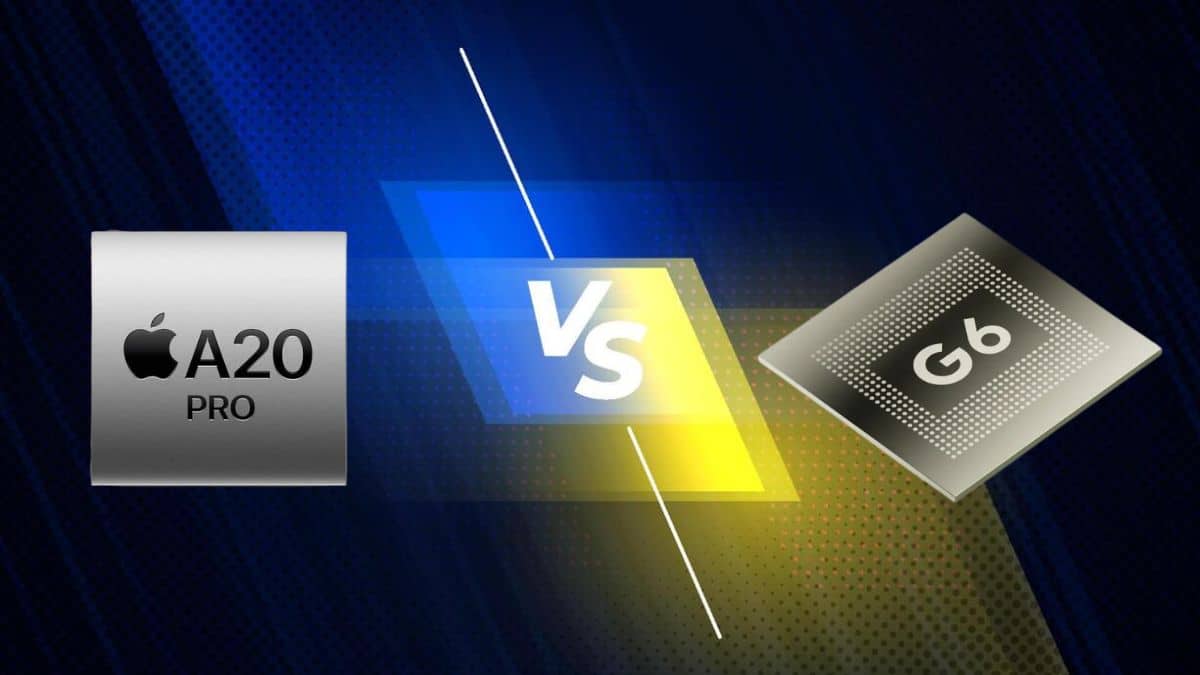
Buying a flagship phone and still waiting on an app export, game load, or video render feels wrong. Apple and Google both promise faster silicon this year, but they built their chips around different priorities.
Apple introduced the A20 Pro with the iPhone 18 Pro lineup on September 9, 2026. Google launched Tensor G6 with the Pixel 11 family on August 12, 2026. Based on confirmed specifications and independent Pixel 11 testing, the answer is clear: A20 Pro is the faster chip for raw CPU and GPU performance.
Tensor G6 has a different job. It accelerates Pixel camera features, Gemini models, and security tasks. That can make a Pixel feel smart without making its processor the fastest.
A20 Pro vs Tensor G6: The Short Answer
| Category | Winner | Why |
|---|---|---|
| CPU speed | A20 Pro | Tensor G6 already trails the older A19 Pro in independent Geekbench 6 tests |
| GPU and gaming | A20 Pro | Apple added a 7-core GPU and claims up to 40% higher graphics performance than A19 Pro |
| Sustained performance | A20 Pro, provisionally | Apple redesigned the package and cooling path, while Tensor G6 loses substantial GPU performance under stress |
| On-device AI | No clean winner | The chips run different models, so benchmark scores do not translate directly across Apple and Google software |
| Pixel camera and Gemini features | Tensor G6 | Google designed its TPU and ISP around Pixel-specific workloads |
If you want the shortest verdict, buy an A20 Pro device for gaming, editing, and maximum processing headroom. Choose a Tensor G6 Pixel for Google’s software features, not because you expect class-leading silicon.
Why the A20 Pro Wins the CPU Comparison
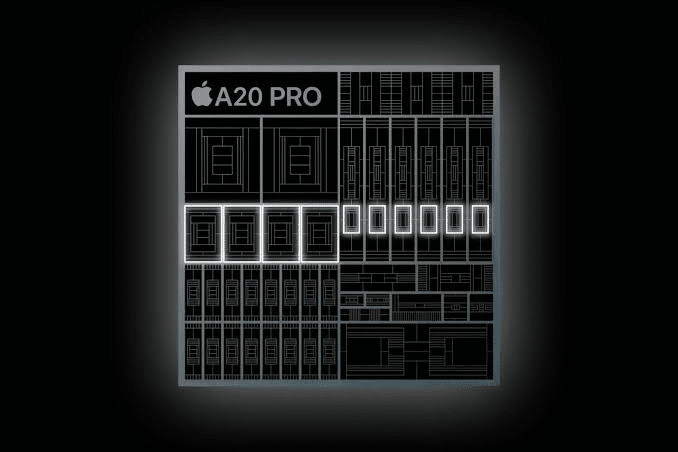
Apple’s A20 Pro uses a 6-core CPU with Neural Accelerators built into each core. Apple says it is up to 20% faster than the A19 Pro and calls it the fastest smartphone CPU. The company has not published a cross-platform benchmark score, so that claim still needs independent testing.
Tensor G6 gives us a useful reality check. A verified Geekbench 6 result for the Pixel 11 Pro scored 2,706 in single-core and 7,223 in multi-core performance. Tom’s Guide recorded similar Pixel 11 Pro results and measured the A19 Pro-powered iPhone 17 Pro Max at 3,871 and 9,968.
That puts the older A19 Pro roughly 43% ahead in single-core performance and 38% ahead in multi-core performance using those results. Since A20 Pro improves on A19 Pro, Tensor G6 would need an implausibly large software-driven gain to reverse the order.
This matters most when one fast core carries the workload. Opening a complex webpage, processing a photo, compiling code, or handling part of a game loop often depends on strong single-core performance. A Pixel 11 can still feel responsive, but responsiveness is not proof that the chips are equally fast.
For a deeper look at Google’s year-over-year gains, see our Tensor G6 vs Tensor G5 comparison.
A20 Pro Has the Stronger GPU Case Too
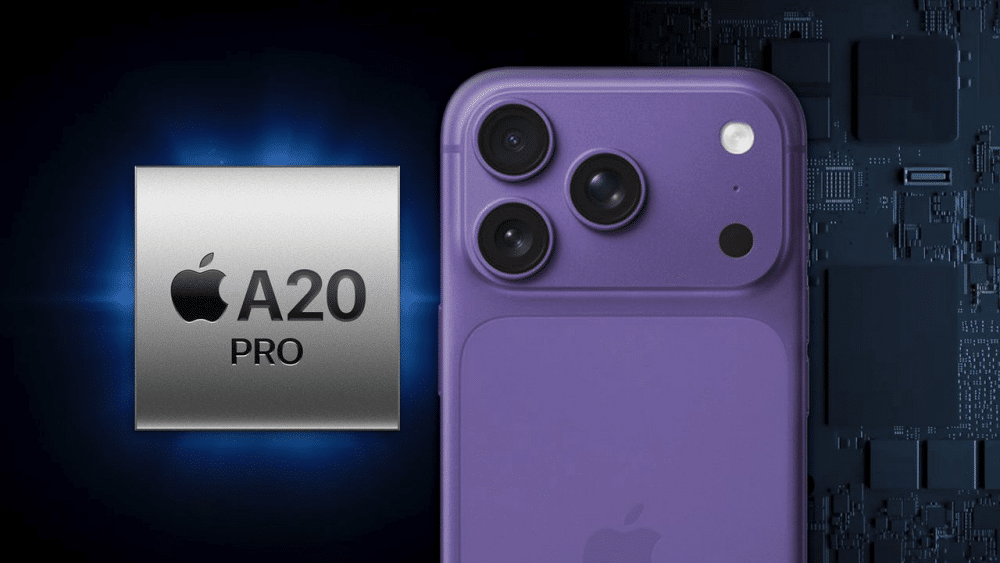
Apple gave A20 Pro a new 7-core GPU and 50% more memory bandwidth than A19 Pro. According to Apple’s A20 Pro announcement, the GPU is up to 40% faster than its predecessor.
Tensor G6 tells a less flattering story. In Android Authority’s Pixel 11 benchmark testing, the chip’s graphics performance started well below current flagship rivals and dropped sharply during a sustained stress test.
That combination matters more than a short peak score. A phone that throttles has less performance available after several minutes of gaming.
Picture the practical difference. A quick puzzle game will run well on either phone. Push higher frame rates, advanced lighting, or a long gaming session, and the A20 Pro’s wider graphics resources and stronger thermal design should create more headroom.
The word “should” matters here. Independent A20 Pro gaming and stress-test data is not yet available, so its exact lead remains unmeasured.
The Manufacturing Node Does Not Decide the Winner
A smaller process can improve transistor density and efficiency, but the node label alone cannot tell you which chip is faster. Architecture, cache, memory bandwidth, clock targets, and cooling all shape the final result.
Apple confirms that A20 Pro uses a 2-nanometer process. Google does not list Tensor G6’s manufacturing node in its public Pixel 11 specifications. Reports conflict between 2nm and 3nm, so treating either figure as confirmed would create false precision.
Focus on measured behavior instead. The Pixel 11’s Tensor G6 results are available today. A20 Pro’s architecture and Apple’s generation-over-generation claims point to a clear lead, but independent tests will show its exact size.
Tensor G6 Is Faster Where Google Wants It to Be
Raw speed is only half of Tensor’s story. Google says Tensor G6 delivers 25% faster web browsing, 15% faster app launches, and 50% more TPU compute than Tensor G5. With the latest Gemini Nano model, supported on-device AI workloads can run up to 3.5 times faster while using up to 3.5 times less energy.
Those numbers do not mean the whole chip is 3.5 times faster. They apply to specific AI workloads using Google’s model and TPU. That distinction often disappears in spec-sheet comparisons.
Tensor G6 also drives faster Night Sight, computational zoom, live translation, and Pixel’s upgraded image pipeline. Our Tensor G6 performance and AI guide explains where those targeted improvements appear.
Apple takes a broader approach with a Dual 16-core Neural Engine and Neural Accelerators inside the CPU. Apple claims twice the AI compute of A19 Pro, but no neutral test can reduce Apple Intelligence and Gemini features to one trustworthy score. Different models, software frameworks, and precision formats make headline AI benchmark comparisons easy to misuse.
Which Chip Should You Choose?
Choose A20 Pro if you care about:
- High-end gaming and graphics
- Video editing and media exports
- Strong single-core speed
- More performance headroom over several years
Choose Tensor G6 if you care about:
- Pixel-exclusive Gemini features
- Google’s computational photography
- Live translation and local AI tools
- Titan M3 and quantum-safe secure boot
The chip should follow the experience you want. Tensor G6 is not slow in ordinary use, but it is not a raw-performance rival to A20 Pro.
Final Verdict
A20 Pro is actually faster. The available evidence already places Tensor G6 behind A19 Pro in CPU tests, while Apple’s new chip adds a faster CPU, a larger GPU, more memory bandwidth, and a redesigned thermal path.
Independent A20 Pro benchmarks will determine the margin, not the winner. Tensor G6 remains valuable because it makes specific Pixel features possible, but Google’s specialization does not erase the performance gap.