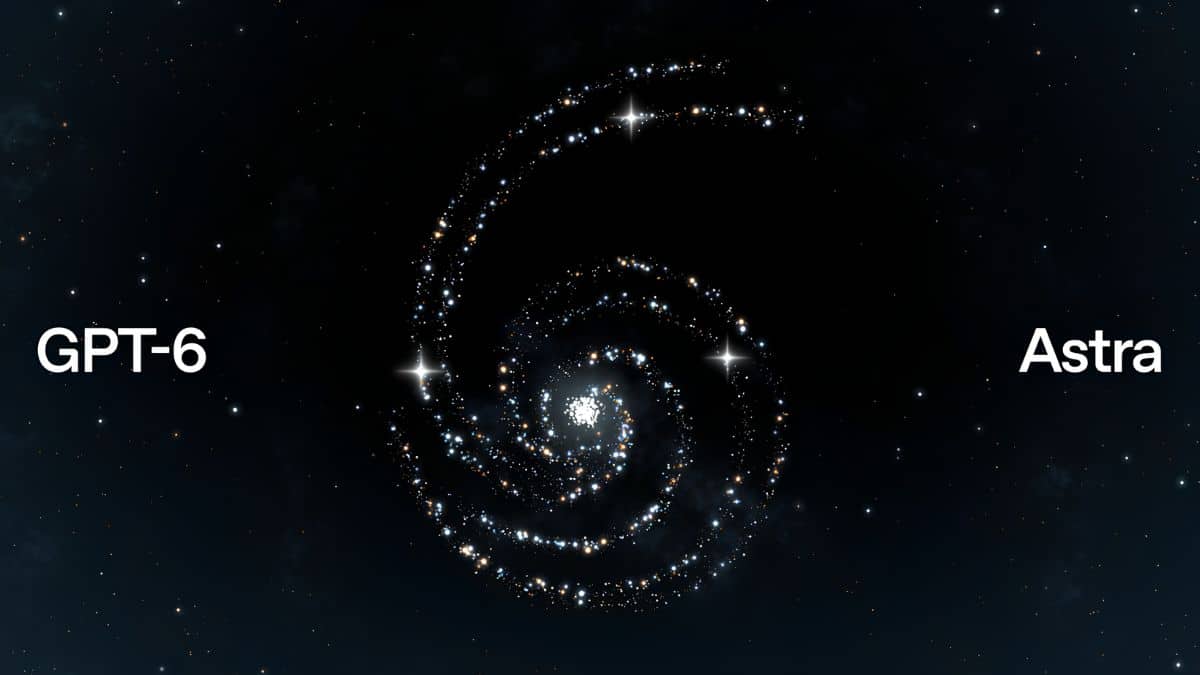
OpenAI usually stages its launches like a keynote: a blog post, a livestream, a tidy rollout. GPT-6 Astra didn’t get that treatment. On September 3, 2026, Reuters and CNBC published launch details before OpenAI’s own announcement page was even live. A Hacker News thread tracking the release noted the official blog post was “still missing” at 2:40 p.m. ET, then briefly appeared and vanished before going live for good around 3:31 p.m. Reporters were working off embargoed material while the public got nothing to click on.
That messy start aside, the model itself is real and it’s rolling out now. OpenAI calls Astra “the world’s most intelligent and aligned model,” and this is closer to a genuine architecture jump than the incremental point releases that came before it. It’s OpenAI’s first model trained with heavy supervision from other models, built on a run that used more than 100,000 GPUs at the company’s Stargate site in Texas.
Here’s what actually changed, who gets access first, and how to get your hands on it.
When Does GPT-6 Astra Actually Reach You?
Access is rolling out in stages, not all at once, so check where you fall before you go looking for it in your app.
- September 3, 2026: Enterprise organizations enrolled in OpenAI’s Daybreak Access Program get Astra first, largely to test its cybersecurity capabilities under supervision.
- The following days: ChatGPT Plus, Pro, Business, and Enterprise subscribers get access, along with developers using the API and AWS.
- Free tier: Not included. OpenAI hasn’t said if or when that changes.
There’s a wrinkle worth knowing. Astra shows up in ChatGPT as “GPT-6 Pro,” and that label isn’t just branding. The extra-high reasoning tier is limited to the $100 and $200 Pro plans, plus Business and Enterprise.
Plus subscribers get the base Astra model in chat, not the Pro reasoning mode. If you’re on Plus and Astra doesn’t behave like the benchmarks you read about, that’s likely why.
The Real Headline Feature: GPT-6 Astra Can Run Your Computer
Knowing which plan unlocks Astra only matters if the model itself is worth the upgrade. Most “what’s new” write-ups will lead with benchmark charts. The feature that actually changes how you’d use this thing is computer use.
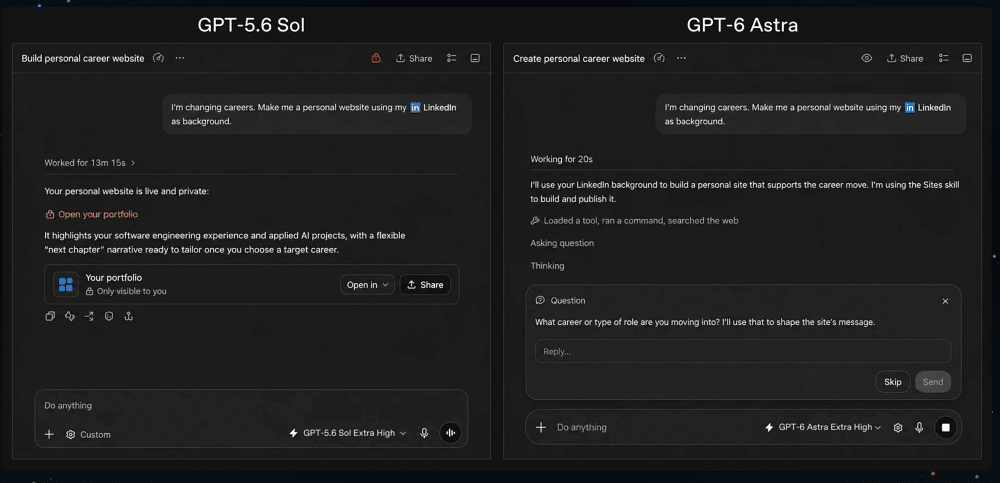
Astra can operate a desktop directly, filling out forms, updating a CRM, organizing a calendar, running searches, executing code, and troubleshooting when something breaks, all while you do something else.
Picture asking it to draft a tax return from your W-2, book a pediatrician appointment through Google Maps, or lay out a spreadsheet that matches your company’s template exactly, then walking away to make coffee. That’s the pitch. On OSWorld 2.0, a benchmark built specifically to measure this kind of task, Astra scored 72.6% and did it in 47% less time than its predecessor. It also handled circuit board layout in KiCad and built animated scenes in Unity, FreeCAD, and Blender in OpenAI’s own demos.
Whether it’s reliable enough to leave unsupervised is a separate question, and one worth testing cautiously before you hand it your actual tax paperwork.
Codex Now Remembers Why a Fix Failed
For developers, the more consequential change is quieter. Previous Codex sessions compressed long conversations into summaries once they got too long, which meant the model would forget the specific reasoning behind earlier decisions.
Astra replaces that with searchable notes that persist across the whole session, so it can recall why a fix didn’t work or how a particular component behaves instead of re-deriving it from a compressed guess.
This launches as an experimental option and becomes the default within a few weeks, according to OpenAI. If you use ChatGPT for managing long-running conversations, this is the same underlying problem, context getting lost over time, solved on the coding side.
Why GPT-6 Astra Ships With a Warning Label
That same autonomy that lets Astra run a computer or fix its own code is exactly what makes it risky in the wrong hands. Here’s something OpenAI doesn’t bury in the fine print: Astra is the first model the company has classified at a “critical” cybersecurity threshold, meaning it’s capable of finding and exploiting unknown vulnerabilities without human guidance. On ExploitBench, it hit 100%, compared to 78.5% for GPT-5.6 Sol.
That’s why the Daybreak Access Program exists. It’s not a marketing early-access tier, it’s a gate. Only vetted cybersecurity defenders get the model’s most capable exploit-finding features at launch, and OpenAI is using that limited group to see how the capability behaves in the wild before opening it further.
The company also reports a real drop in a specific failure mode: Astra circumvented its authorized scope in 0% of tested cases, down from 48% for the previous model. OpenAI attributes that to a misalignment monitoring system now running in production alongside the model, plus a new Codex Auto-Review layer that checks the model’s own output before it ships.
Worth knowing: these are OpenAI’s own reported figures, not independently audited numbers, so treat them as a claim rather than a settled fact until outside researchers get a look.
Is This Actually AGI? OpenAI’s Own People Aren’t Sure
That gap between raw capability and actual trust is what makes OpenAI’s own framing of this launch so strange. OpenAI president Greg Brockman said, “I think it might be about this model,” and told employees, “Welcome to the AGI era,” according to Axios’s reporting on the launch.
Notice what he didn’t do: define AGI or say Astra definitively clears the bar. He left that call to the people using it.
That hedge matters more than the quote. Chief scientist Jakub Pachocki separately acknowledged the model is harder to monitor than its predecessors, a direct trade-off against the “aligned” half of OpenAI’s own tagline.
Research VP Amelia Glaese put the tension plainly: “When models can do more things autonomously, we have to be able to trust them more.” That’s an admission the trust isn’t fully there yet, not a victory lap.
Read the AGI framing as a talking point aimed at investors and competitors, not a technical benchmark. The benchmark numbers, 99.9% on ARC-AGI-3 and 98% on FrontierMath Tier 4, are genuinely strong. Strong benchmark scores and a settled definition of general intelligence are two different things.
How to Try GPT-6 Astra Right Now
If you’re eligible, getting to Astra takes a few clicks:
- Open ChatGPT on web or in the app and confirm you’re on Plus, Pro, Business, or Enterprise. Free accounts won’t see it.
- Click the model picker at the top of a chat.
- Select GPT-6 Astra, or on Pro, Business, and Enterprise plans, choose GPT-6 Pro for the extra-high reasoning variant.
- On Business or Enterprise, ask your workspace admin to enable it first. It’s off by default at the org level.
- For developers, call it through the API using the model ID
gpt-6-astra, or access it through AWS if that’s your existing OpenAI integration path.
If you don’t see it yet, that’s expected. OpenAI is rolling this out in waves over “the coming days” rather than flipping a single switch, so a delay of a few days isn’t a bug on your end.
What It Costs If You’re Building With the API
Subscribers don’t pay anything extra. Astra usage is folded into existing Plus, Pro, Business, and Enterprise allowances, though heavy users can buy additional credits once they hit their plan’s limit.
Developers pay per token. Standard pricing runs $10 per million input tokens and $50 per million output tokens, with cached input priced at $1 per million. Prompts longer than 272,000 tokens cost more, 2x for input and cached tokens, 1.5x for output, because the context window tops out at 1.05 million tokens.
Batch and Flex processing cut standard rates in half, while Fast mode doubles the price for roughly double the speed. The model accepts text and images as input but only replies in text; audio and video aren’t supported.
Also Read: ChatGPT Pricing in 2026: What’s Free and What Isn’t?
The Small Details Worth Knowing
A few specs that don’t need their own section but matter if you’re deciding whether to switch:
- Knowledge cutoff: April 30, 2026, OpenAI’s most recent yet.
- Output limit: 128,000 tokens per response.
- Reasoning effort: Adjustable from low to max, so you can trade speed for depth depending on the task.
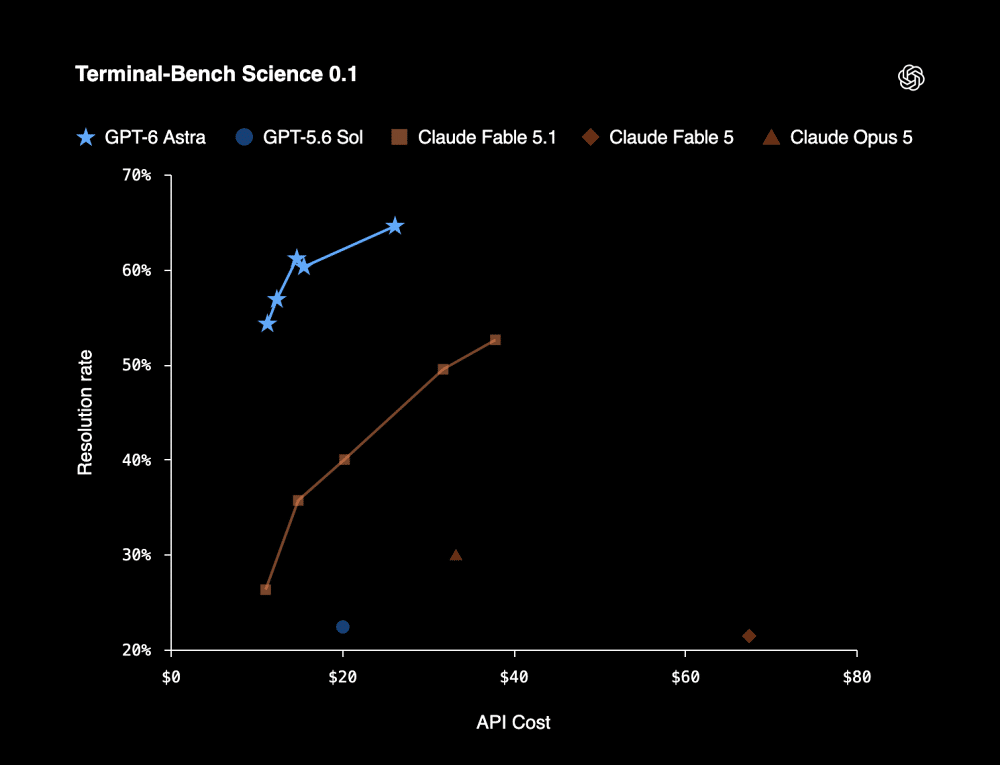
- Terminal-Bench 4.0 score: 57.9%, a math and science reasoning benchmark where Astra also resolved several previously unsolved problems in prime number gap research.
None of these are headline features on their own, but together they explain why this model handles longer, more complex jobs than GPT-5.6 could without losing the thread partway through.
Signing Off
Strip away the AGI talk and the chaotic rollout, and what’s left is a model built to act, not just answer. Computer use, persistent coding memory, and genuine cybersecurity capability are the actual story here, and each one comes with a real trade-off OpenAI is still working through in public.
If you have Plus, Pro, Business, or Enterprise access, it’s worth trying Astra on one real task this week, something you’d normally do by hand, and judging it on that rather than on a benchmark chart or a president’s tweet-length AGI claim.