
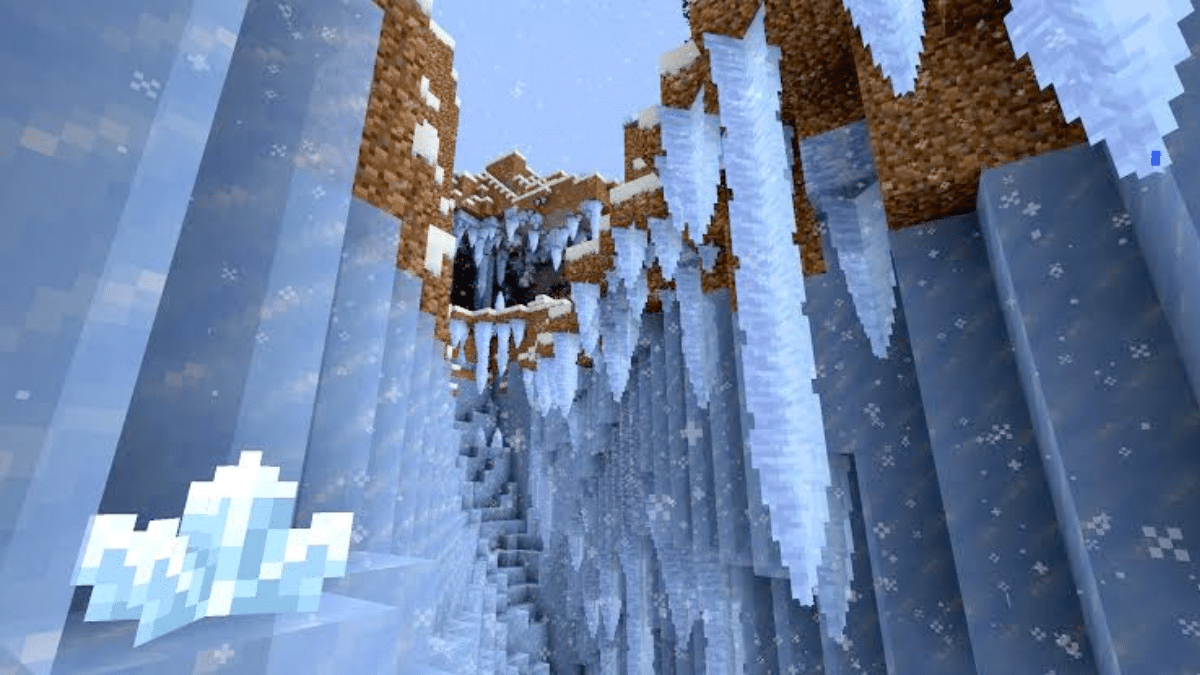
Ice Caves are the first new cave biome Mojang has added since Deep Dark, and they headline the Fourth Drop of 2026. The drop was announced at Minecraft LIVE in September 2026. As of October 20, 2026, you can only play it in test builds: Java Edition 26.4 snapshots and Bedrock Preview.
Mojang added the biome in Bedrock Preview 26.60.29 on September 30, 2026. Java followed with 26.4 Snapshot 3 on October 6, 2026. The full release is planned as Java 26.4 and Bedrock 26.70 in Q4 2026, but Mojang has not confirmed a date. All stats below come from current test builds and may change before launch.
Where to find Ice Caves in Minecraft?
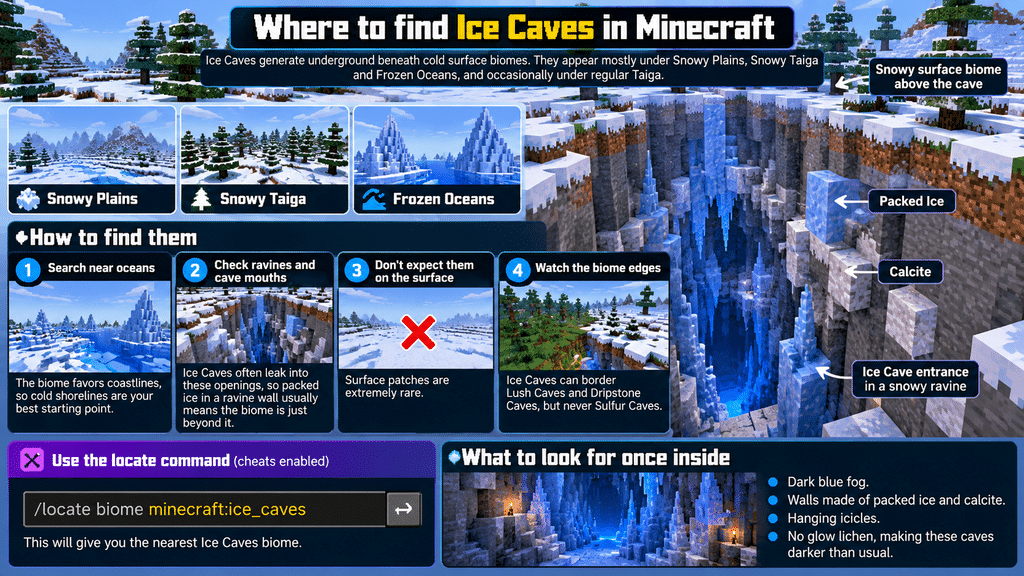
Ice Caves generate underground beneath cold surface biomes. They appear mostly under Snowy Plains, Snowy Taiga and Frozen Oceans, and occasionally under regular Taiga.
Use these terrain signals to narrow your search:
- Search near oceans. The biome favors coastlines, so cold shorelines are your best starting point.
- Check ravines and cave mouths in snowy terrain. Ice Caves often leak into these openings, so packed ice in a ravine wall usually means the biome is just beyond it.
- Don’t expect them on the surface. Surface patches are extremely rare.
- Watch the biome edges. Ice Caves can border Lush Caves and Dripstone Caves, but never Sulfur Caves.
With cheats enabled, the fastest route is the locate command: /locate biome minecraft:ice_caves
Once inside, you’ll notice dark blue fog and walls made of packed ice and calcite. There is also no glow lichen, which makes these caves darker than usual.
What generates inside Ice Caves
The walls are mostly packed ice, broken up by calcite blobs. Stone and deepslate pockets also sit inside the ice, and the ores spawn in those pockets.
All the standard ores appear, including coal, iron, copper, gold, redstone, lapis and diamond. Amethyst geodes, monster rooms and mineshafts can also generate. Mineshaft support was added in Java Snapshot 4.
Notably, ice crystals and icicles generate naturally only in Ice Caves. That makes this biome the only renewable source of both blocks outside Wandering Trader stock.
New blocks in Ice Caves
1. Icicle
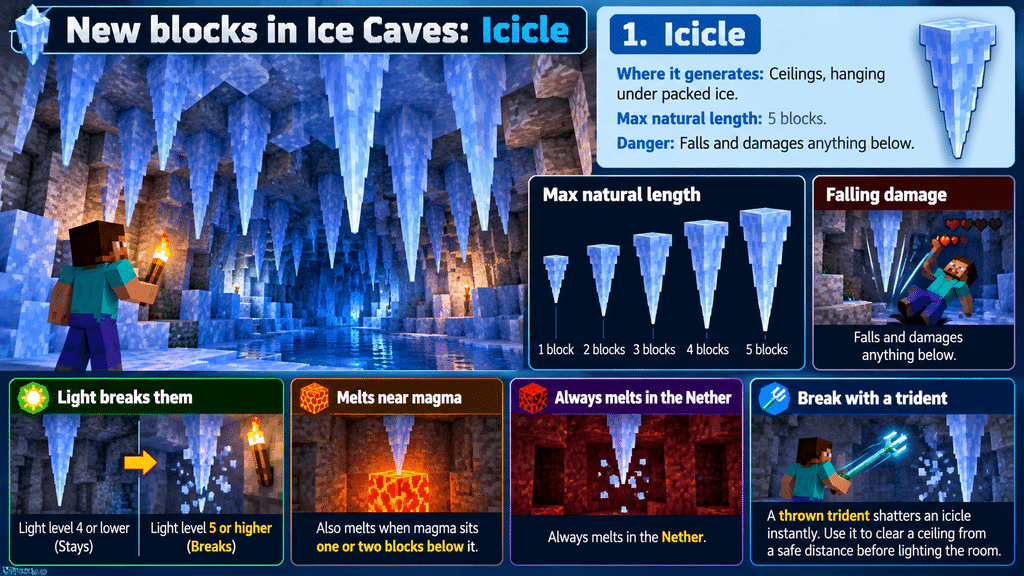
- Where it generates: Ceilings, hanging under packed ice
- Max natural length: 5 blocks
- Danger: Falls and damages anything below
Icicles work like pointed dripstone, with one key difference: light breaks them. An icicle melts once the block light around it reaches 5 or higher. It also melts when magma sits one or two blocks below it, and always in the Nether.
That light rule is the biome’s real trap. Placing a torch in an icicle-heavy room can drop the whole ceiling on your head. Lava lakes in Ice Caves can also trigger falls and catch nearby mobs.
A thrown trident shatters an icicle instantly. Use it to clear a ceiling from a safe distance before lighting the room.
2. Brittle ice
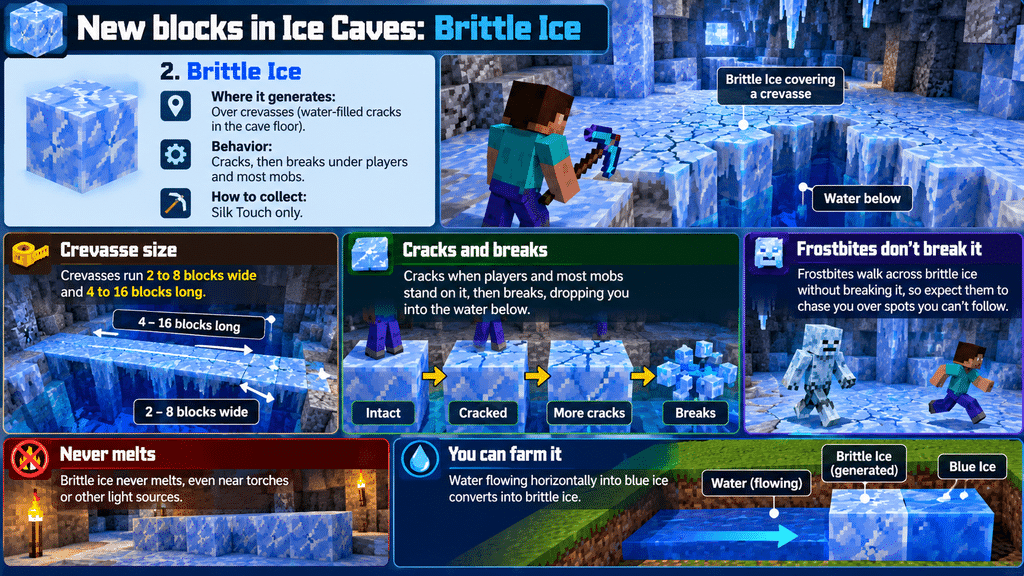
- Where it generates: Over crevasses (water-filled cracks in the cave floor)
- Behavior: Cracks, then breaks under players and most mobs
- How to collect: Silk Touch only
Crevasses run 2 to 8 blocks wide and 4 to 16 blocks long. They’re covered with brittle ice that gives way after you stand on it, dropping you into the water below.
Frostbites walk across brittle ice without breaking it, so expect them to chase you over spots you can’t follow. Brittle ice also never melts.
You can farm it too. Water flowing horizontally into blue ice converts into brittle ice.
3. Ice crystal
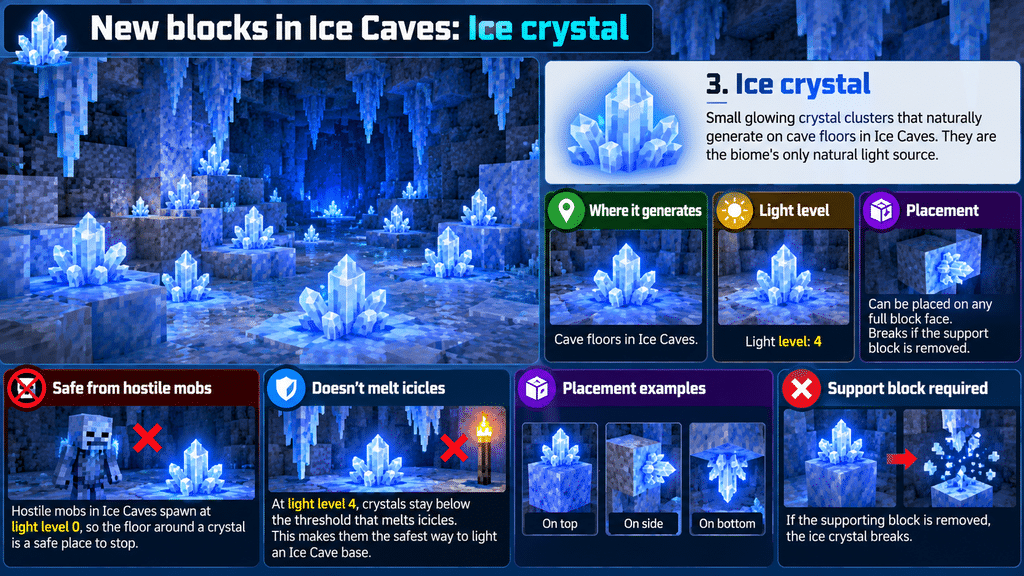
- Where it generates: Cave floors
- Light level: 4
- Placement: Any full block face; breaks if the support block is removed
Ice crystals are the biome’s only natural light source. Hostile mobs in Ice Caves spawn at light level 0, so the floor around a crystal is a safe place to stop.
At light level 4, crystals also stay below the threshold that melts icicles. That makes them the safest way to light an Ice Cave base without bringing the ceiling down.
Mobs in Ice Caves
Ice Caves spawn the usual cave hostiles: creepers, skeletons, spiders, zombies and endermen. Glow squid and drowned appear in aquifers. The two signature mobs are the Stray and the new Frostbite.
Strays can spawn here without powder snow above them, which is not the case in surface biomes.
Frostbite stats and behavior
The Frostbite is a zombie variant, and it is tougher than a regular zombie. The table below shows Java Snapshot 4 values.
| Stat | Value |
|---|---|
| Health | 24 HP (12 hearts) |
| Armor | 2 |
| Melee damage | 2.5 / 3 / 4.5 HP (Easy / Normal / Hard) |
| Melee effect | Freezing for 3 seconds |
| Ice ball damage | 1 to 4 HP, based on speed |
| Ranged trigger | Throws ice balls from up to 16 blocks |
| Spawn chance in Ice Caves | 9.62% (highest of any biome) |
| Drops | Rotten flesh, ice balls (75% chance, 0 to 3) |
Frostbites switch between melee and ranged attacks. About a quarter of them spawn holding ice balls and throw them from range, then switch to melee within 2 blocks. They also pick up and throw any ice balls lying on the ground.
They burn in sunlight, and they’re undead, so Smite works on them. A Frostbite turns back into a zombie after 30 seconds underwater.
Zombies and husks become Frostbites after time in powder snow. Drowned need two steps: they turn into zombies first, then into Frostbites. Mojang hasn’t published official conversion times.
The Freezing effect, and how to counter it
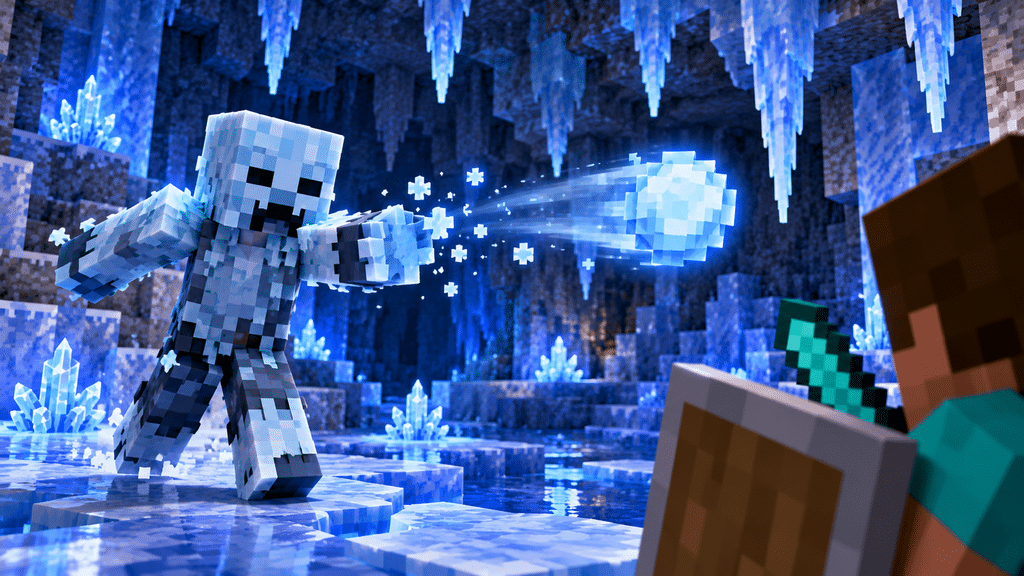
Freezing is a status-effect version of powder snow. It slows you, makes your screen shake and deals damage over time.
Leather armor stops the freeze damage but doesn’t remove the effect itself. That makes leather the most useful set for exploring Ice Caves, even though its overall protection is weak.
You can also use Freezing against other mobs:
- Potion of Freezing: Awkward Potion + Ice Ball, lasts 0:45. Add Redstone to extend it to 1:30.
- Splash and lingering versions: brewed the usual way with Gunpowder and Dragon’s Breath.
- Arrow of Freezing: eight arrows around a lingering Potion of Freezing.
Importantly, blazes, magma cubes and striders take 5× damage from Freezing. That makes splash Potions of Freezing a strong pick for Nether fortress runs.
Signing Off
Ice Caves turn lighting, normally your safest habit underground, into a hazard. Torches drop icicles, the floor can give way, and the main enemy hits harder than a zombie while freezing you. Crystals, leather armor and a trident handle most of it.
Mojang is still adjusting the biome. Snapshot 4 alone added crevasses and mineshafts, so expect more changes before the Q4 2026 release.
Ice Caves are a cave biome from Minecraft’s Fourth Drop 2026. They’re made of packed ice and calcite, and they generate under cold surface biomes.
Three: icicles, brittle ice and ice crystals. The drop also adds the ice ball item, Potions of Freezing and Arrows of Freezing.
Only in test builds. On Java, enable snapshots in the Minecraft Launcher’s Installations tab. On Bedrock, use Minecraft Preview. Back up your worlds first.
Partly. Leather armor prevents freeze damage from the Freezing effect, but you still take normal melee and ice ball damage.
Yes. Diamonds and other ores generate inside the stone and deepslate pockets within the ice.