
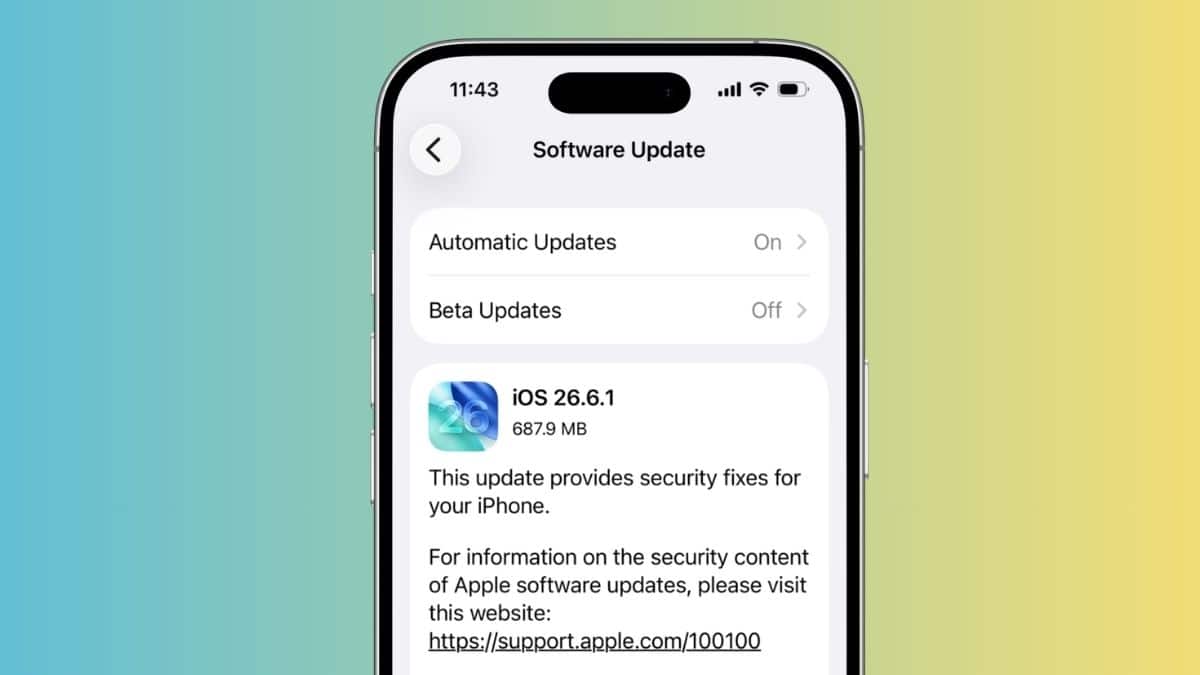
You just updated to iOS 26.6 a few weeks ago. Now another update notification is sitting in Settings. That’s not a bug in your update cycle. Apple found real security issues after the last release and moved fast to close them.
Apple shipped iOS 26.6.1 on August 17, 2026, carrying build number 23G83. It’s a security-only release. No new features, no interface changes, nothing to explore. Here’s what actually changed and whether you should install it today.
iOS 26.6.1 Release Date, Build Number, and Compatible Devices
- Release date: August 17, 2026
- Build number: 23G83
- Compatible iPhones: iPhone 11 and later
- Compatible iPads: iPad Pro 12.9-inch (3rd generation and later), iPad Pro 11-inch (1st generation and later), iPad Air (3rd generation and later), iPad (8th generation and later), iPad mini (5th generation and later), running iPadOS 26.6.1
- Older devices: iOS 18.7.10 and iPadOS 18.7.10 cover iPhones and iPads that can’t run the 26.x line
- Also released the same day: macOS Tahoe 26.6.2, visionOS 26.6.1
Check your current version under Settings > General > About > Software Version before you update, so you know whether the notification even applies to you.
Nearly 30 Security Vulnerabilities Get Patched
This is the real reason to update. Apple’s security notes for iOS 26.6.1 and iPadOS 26.6.1 list close to 30 fixed vulnerabilities, and the majority sit inside WebKit, the engine that renders web pages in Safari and any app with an in-app browser. A malicious webpage could trigger memory corruption or crash Safari outright on an unpatched device.
The rest of the list touches components most people never think about. An Audio flaw (CVE-2026-65339) could let an app quietly leak sensitive user information. An ImageIO bug (CVE-2026-65346) involved an integer overflow that opened the door to arbitrary code execution just from processing a malformed image. Several kernel issues, including a use-after-free bug (CVE-2026-65343), could crash the system or expose kernel memory to an attacker.
One fix stands out for anyone using enterprise networks or a VPN. CVE-2026-65329 was a Telephony flaw that let an attacker bypass IPSec authentication through a state management weakness, meaning someone positioned on the network could potentially slip past the encrypted tunnel meant to keep traffic private. Apple’s notes don’t list any of these as actively exploited in the wild, but published fixes tend to speed up exploitation attempts once attackers reverse-engineer the patch. That’s the real argument for updating now instead of waiting.
AI Helped Find the Bugs This Time
Here’s a detail most coverage of this update skipped. Apple credits OpenAI Codex Security, and specifically a researcher named Amy Burnett, with discovering at least eight of the WebKit vulnerabilities patched here. That’s a meaningful shift. Automated, AI-assisted vulnerability research is now finding real bugs in Apple’s code fast enough to land in a point release, not just an academic paper.
No New Features, and That’s Fine
iOS 26.6.1 doesn’t touch Messages, Maps, Spotlight, or any of the features iOS 26.6 introduced last month. That’s by design. Apple is closing out the current iOS line while iOS 27 finishes development for its expected mid-September 2026 launch. A security-only patch this close to a major release is a good sign, not a red flag.
How to Install iOS 26.6.1 on iPhone
- Open Settings and tap General.
- Tap Software Update.
- Tap Update Now once iOS 26.6.1 appears.
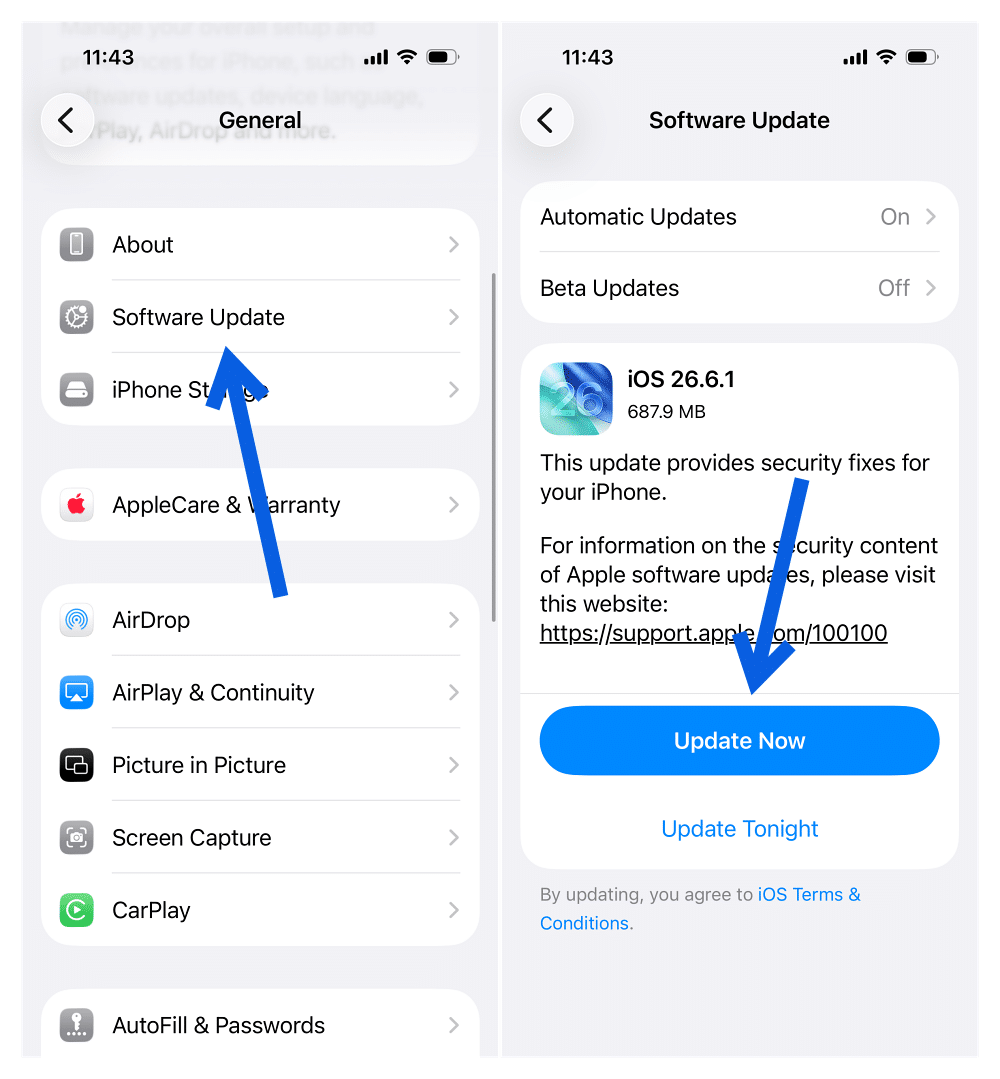
- Let your iPhone restart. Back up to iCloud or your computer first if you haven’t recently.
Final Thoughts
iOS 26.6.1 won’t change how your iPhone looks or feels, and that’s the point. Close to 30 security holes, most of them in WebKit, get closed before iOS 27 arrives next month. Skip the wait and install it as soon as it shows up in Settings.
Check out these helpful guides too: