

You follow a cricket score account on WhatsApp. You’re also subscribed to a deals channel, a news outlet, and at least one meme page on Telegram. Neither of those relationships looks like a normal chat. Nobody’s typing back, nobody’s marked “online,” and yet updates keep landing in your feed like clockwork.
That’s not an accident. It’s the same idea built twice by two companies that approached the problem at different moments.
Telegram introduced Channels in September 2015 as a tool built specifically for broadcasting to large audiences without turning every update into a group chat free-for-all. WhatsApp arrived much later, quietly testing Channels in Colombia and Singapore in June 2023 before Meta expanded the feature to more than 150 countries that September.
Today, both platforms operate at massive scale. Meta says the Updates tab, where WhatsApp Channels live, is used by 1.5 billion people every day. Telegram, meanwhile, entered 2026 with AI-generated summaries for long channel posts and a redesigned Liquid Glass interface on iOS.
On the surface, the idea is identical. Follow an account, receive one-way updates, and never worry about replies burying the news you actually wanted to see. Once you start using them, though, the differences become much more obvious.
WhatsApp Channels vs. Telegram Channels at a Glance
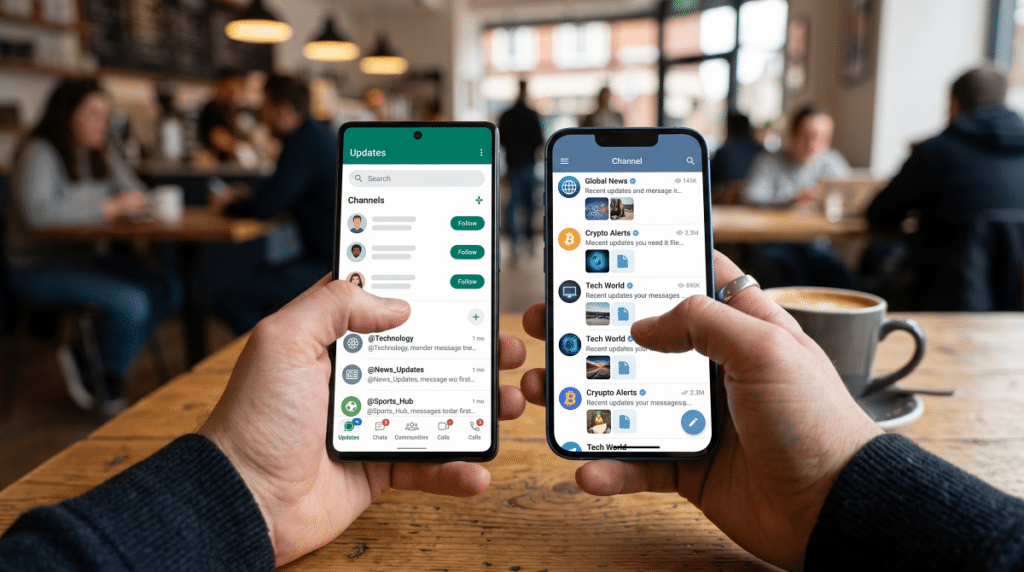
Before diving into the details, here’s the biggest distinction:
| Feature | WhatsApp Channels | Telegram Channels |
|---|---|---|
| Launch | 2023 | 2015 |
| Audience interaction | Emoji reactions, limited private messaging | Reactions, linked discussion groups |
| Admin support | Multiple admins | Up to 50 admins with granular permissions |
| Monetization | Rolling out subscriptions and promoted channels | Ads, Telegram Stars, paid content |
| Notifications | Muted by default | Enabled by default |
| View counts | Admin only | Visible to everyone |
| AI features | None | AI summaries for long posts |
While both serve the same purpose, Telegram has evolved into a publishing platform, whereas WhatsApp focuses on making broadcasting feel familiar inside an app people already use every day.
What Is a Channel, and How Is It Different From a Group?
A channel on either platform is a broadcast, not a conversation.
An admin publishes updates, followers receive them, and nobody in the audience can reply directly inside the main feed. That’s the entire idea, and it’s also what confuses people coming from traditional group chats where everyone participates equally.
WhatsApp separates Channels from personal conversations by placing them inside the dedicated Updates tab alongside Status updates. Your private chats remain completely separate.
Telegram takes a different approach. Channels appear alongside your personal chats and groups in the main conversation list, usually identified by a small megaphone icon next to the name.
Telegram also gives admins another option that WhatsApp currently doesn’t offer. A discussion group can be linked directly to a channel, allowing followers to comment and discuss posts without cluttering the broadcast feed itself.
WhatsApp doesn’t have an equivalent feature.
If you want to respond to a WhatsApp Channel update, your options are generally limited to reacting with an emoji or, on supported channels, sending the admin a private message.
Followers vs. Subscribers: How Large Can a Channel Grow?
Neither platform places a practical limit on audience size.
WhatsApp calls them followers, while Telegram refers to them as subscribers, but both platforms support channels with millions of members.
The more interesting difference is what admins can actually see.
According to Telegram’s published limits, subscriber counts are unlimited. However, admins can only browse a visible list of roughly the first 200 subscribers, even if their channel has millions of followers. Telegram also limits channel names and descriptions to a combined 255 characters and usernames to between five and 32 characters. Premium users can reserve up to 20 public usernames, while free users are limited to 10.
WhatsApp doesn’t publish a comparable technical limits page. Admins can view overall follower counts through channel analytics, but individual followers remain anonymous to both the admin and one another by default.
So while audience size is effectively unlimited on both services, Telegram exposes slightly more operational detail, whereas WhatsApp places a stronger emphasis on follower privacy.
Admin Tools: WhatsApp Keeps Things Simple, Telegram Goes Much Further
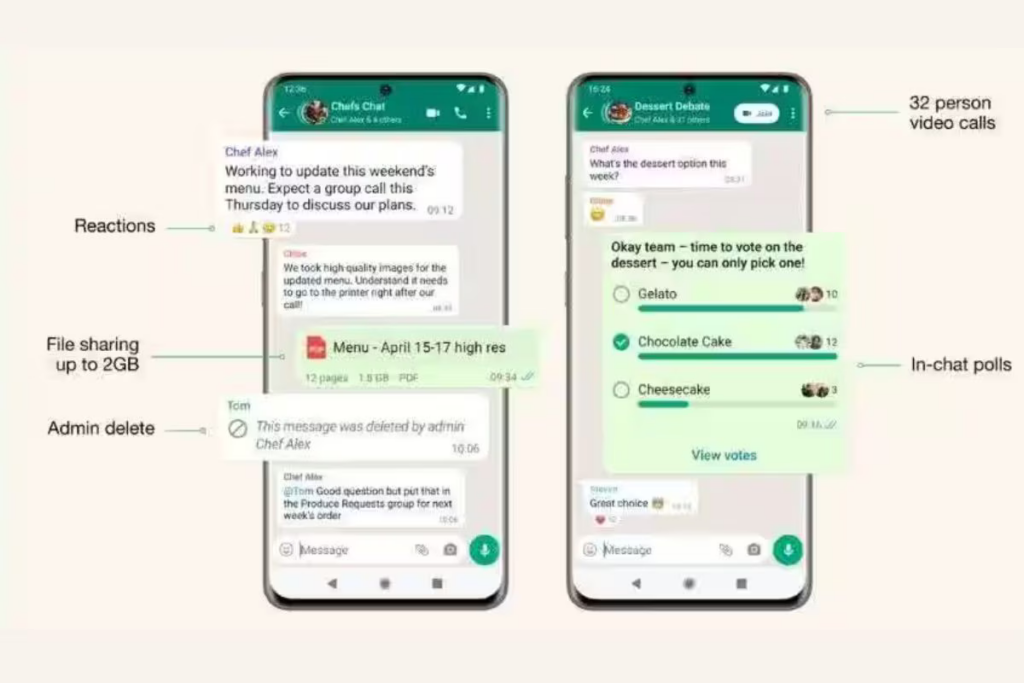
This is where the two platforms begin to feel like they’re designed for completely different audiences.
WhatsApp Channels originally supported only a single admin. That changed in February 2024 when Meta introduced multiple admin support, allowing channel owners to delegate publishing responsibilities without sharing account credentials.
The toolkit, however, remains intentionally straightforward.
Admins can publish:
- Text updates
- Photos
- Videos
- Voice notes
- Polls
- Stickers
Meta also allows channel updates to be edited for up to 30 days before they’re automatically removed from its servers.
Telegram approaches channel management from the opposite direction.
Channels support as many as 50 administrators, including bots, with detailed permission controls for posting, editing, deleting content, inviting administrators, banning users, and managing discussions.
Unlike WhatsApp, Telegram doesn’t impose a time limit on editing posts. It also includes a dedicated Content Protection option that prevents followers from forwarding or saving posts, a feature with no direct equivalent on WhatsApp.
For an individual creator or a small business, WhatsApp’s simpler interface can actually be an advantage.
For publishers, media organizations, educational communities, or anyone managing a large audience, Telegram offers a far more capable administration toolkit.
Reactions, Icons, and Reading a Channel at a Glance
WhatsApp keeps reactions intentionally minimal.
Channel followers can react using one of six preset emojis, and admins can choose whether those reactions remain enabled or disable them entirely. Everyone can see the total number of reactions, but individual users remain anonymous.
That privacy-first approach is consistent with the rest of WhatsApp.
Interestingly, WABetaInfo has already spotted support for custom emoji reactions in Android beta builds, suggesting the current six-emoji limitation may not last forever.
Telegram offers a richer experience.
Custom emoji reactions are available, with some reserved for Premium subscribers. Posts can also display view counts through the familiar eye icon, edited messages receive a pencil indicator, and administrators can optionally sign their posts, making it clear who published each update.
If you’re a regular Telegram user, understanding these visual indicators makes navigating channels much easier.
Our complete guide to Telegram icons and symbols explains what each icon means across chats, channels, calls, and settings.
Also Check: WhatsApp Icons and Symbols Meaning Explained: A Complete Guide
Monetization: Which Platform Actually Pays Creators?

This is one of the biggest differences between the two platforms today.
Telegram already has a mature monetization system. Channels with more than 1,000 subscribers can participate in the Telegram Ad Platform and earn a share of advertising revenue generated from sponsored messages. Telegram also supports Telegram Stars, allowing subscribers to tip creators or pay for premium content directly within the app.
For most creators, it’s not life-changing money, but it’s real infrastructure that’s already available and being used by thousands of channel owners.
WhatsApp is still catching up.
In June 2025, Meta announced three major additions to the Updates tab:
- Paid channel subscriptions
- Promoted Channels in the directory
- Ads inside Status
Importantly, all of these features remain confined to the Updates tab and never appear inside private chats.
As of mid-2026, however, the rollout is still gradual. Depending on your country, you may not see channel subscriptions available yet.
It’s also worth clearing up a common point of confusion.
WhatsApp Plus, Meta’s $2.99-per-month subscription introduced globally in May 2026, is completely separate from Channel subscriptions. WhatsApp Plus gives individual users premium stickers, themes, and additional app features. It doesn’t help creators earn money or affect channel monetization in any way.
Privacy: What Channel Followers Can and Can’t See
Privacy is a priority on both platforms, but they handle transparency differently.
Neither WhatsApp nor Telegram exposes your phone number to other followers in the same channel, which has become the expected baseline for broadcast features.
Beyond that, their philosophies begin to diverge.
Telegram displays public view counts beneath every channel post, allowing anyone to see approximately how many people viewed an update. WhatsApp keeps those analytics private, making them visible only to channel admins.
Telegram also allows administrators to sign individual posts, revealing exactly who published each update if they choose to enable the feature.
WhatsApp takes the opposite approach. Channel admins remain anonymous to followers by default, and there’s currently no equivalent option to display individual author names beneath posts.
Smaller Differences That Matter in Everyday Use
Some of the biggest day-to-day differences aren’t headline features at all.
Notifications
The two apps make opposite assumptions about how you want to receive updates. WhatsApp automatically mutes every channel you follow, so you’ll only receive notifications if you manually enable them.
Telegram does the reverse. New channels send notifications immediately unless you choose to mute them yourself.
AI Features
Telegram continues to push ahead with AI-powered tools. Beginning with the January 3, 2026 update, long channel posts and Instant View pages can be summarized automatically using AI models running on Telegram’s Cocoon network.
WhatsApp Channels currently offer nothing comparable.
Interface Design
The two apps have also taken different visual directions. Telegram introduced a broader Liquid Glass redesign for iOS in early 2026, complete with adjustable transparency effects inside the Power Saving settings.
WhatsApp’s Channel interface has remained largely unchanged during the same period. Individually, none of these differences feels especially significant.
Together, though, they explain why Telegram channels often feel more feature-rich, transparent, and customizable, while WhatsApp Channels remain intentionally simple and uncluttered.
WhatsApp Channels vs. Telegram Channels: Which One Should You Use?
Choosing between them depends less on features and more on what you’re trying to accomplish.
Choose WhatsApp Channels if:
- You already spend most of your day on WhatsApp.
- You want the simplest possible way to follow brands, creators, or news updates.
- Privacy matters more than public engagement metrics.
- You prefer fewer settings and a cleaner experience.
Choose Telegram Channels if:
- You manage a large audience or community.
- You need multiple admins with detailed permissions.
- You want built-in monetization.
- View counts, AI summaries, discussion groups, and advanced moderation tools are important to you.
For casual followers, WhatsApp often feels more approachable because there’s virtually no learning curve.
For creators and publishers, Telegram still offers significantly more flexibility.
Final Thoughts
Neither platform gets Channels wrong. They’re simply solving different problems.
WhatsApp Channels benefit from living inside an app billions of people already open throughout the day. Following a channel takes almost no effort, updates stay separate from personal conversations, and Meta continues making discovery easier through Promoted Channels and improvements to the Updates tab.
Telegram Channels ask more from both creators and subscribers, but they reward that extra complexity with powerful moderation tools, built-in monetization, public engagement metrics, AI features, and a level of customization WhatsApp hasn’t matched yet.
If you’re simply looking for the easiest way to keep up with your favorite creators, sports teams, or news outlets, WhatsApp Channels are likely enough.
If you’re building something you intend to grow into a serious publication or community, Telegram still provides the stronger toolkit.
Don’t miss these related reads: