You’re at the gym, a bar, or a work meeting, and the person across from you is wearing sunglasses indoors. No red light, no raised phone, nothing that says “recording.” With Ray-Ban Meta and Snap Spectacles now selling in the millions, that’s no longer a hypothetical. The camera is built into the frame, and there’s no visual cue to tell you it’s active.
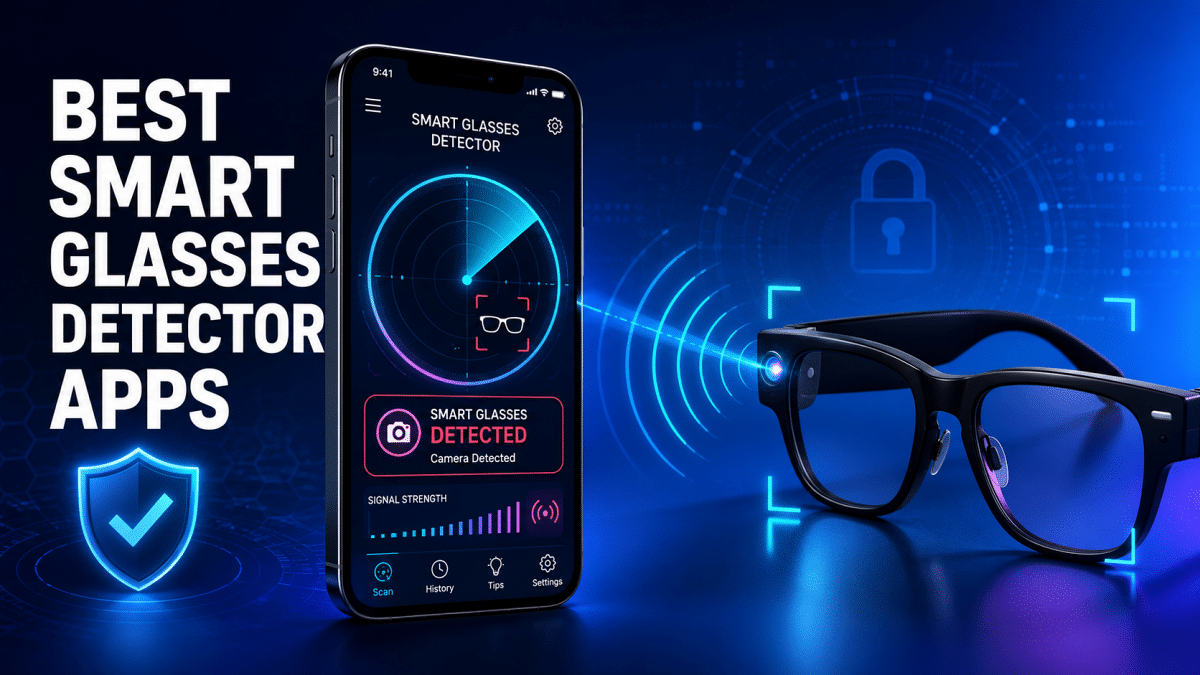
That gap is why a new category of app exists. Smart glasses detector apps scan for the Bluetooth signal these devices broadcast, or check optically for a camera lens, and warn you when one is nearby. Below are five that actually work, what each one costs today, and where each one falls short.
What a Smart Glasses Detector App Does
Most apps in this category use Bluetooth Low Energy (BLE) scanning. Every Ray-Ban Meta, Snap Spectacles, or similar pair advertises a manufacturer identifier over Bluetooth so it can pair with a phone and sync notifications. Detector apps listen for those identifiers in the background and fire an alert when one comes into range, usually with a rough distance estimate based on signal strength.
A smaller set of apps takes a different route: pointing your phone’s camera at a person or object to spot the telltale glint of a lens, sometimes paired with infrared or magnetic-field checks. This method catches a camera that has Bluetooth turned off, but it requires you to manually aim your phone, and it can’t run passively in your bag.
Neither method sees through walls or guarantees a match. Every app in this list is scanning for a signal or a reflection, not confirming that someone is actually recording you.
Why Smart Glasses Detector Apps Matter Right Now
A phone held up to record is a visible, social signal. Smart glasses remove that signal entirely, which is exactly why the backlash started in 2026, with viral posts about people identifying strangers in public within seconds using Meta’s AI features.
Detector apps became the direct countermeasure: since these glasses keep broadcasting Bluetooth even when idle, that constant chatter is also their biggest weakness, and it’s the one thing an app on your phone can catch.
5 Best Smart Glasses Detector Apps for iPhone and Android
Every app below is currently live on the App Store or Google Play. Pricing, ratings, and features are pulled straight from each store listing. Four use Bluetooth scanning; the fifth uses a completely different method, which matters more than it sounds.
1. Nearby Glasses (Original)
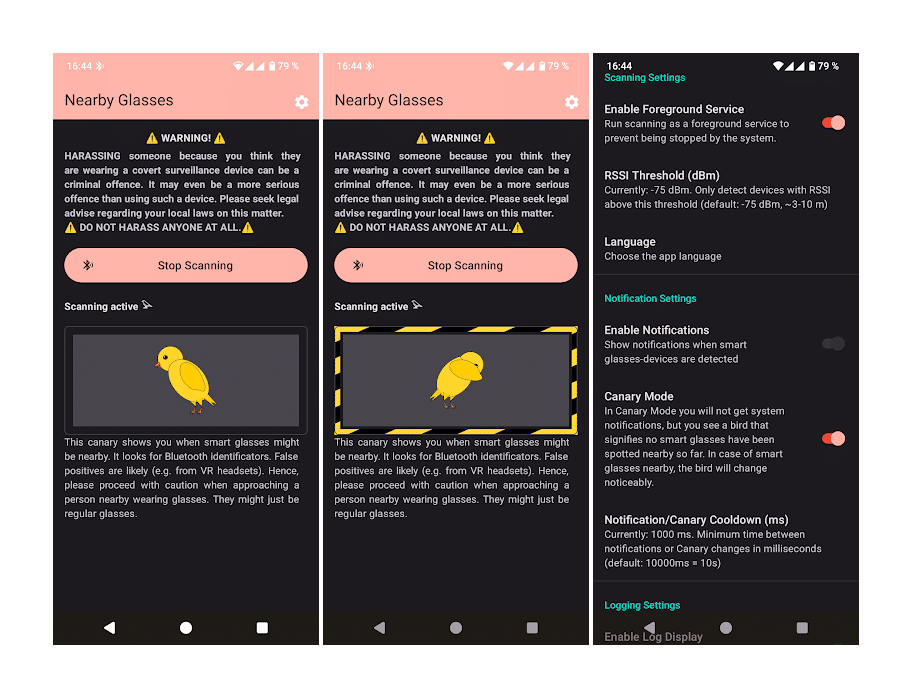
This is the app that started the category. Built by developer Yves Jeanrenaud and published by my PocketPC GmbH, it scans for the Bluetooth company identifiers that Ray-Ban Meta, Snap Spectacles, and similar glasses broadcast in their advertising frames, then sends a notification when one is close by.
It’s free, open source under AGPL-3.0, collects no data, and runs no ads, which is rare for anything in this list. The Android version has over 100,000 downloads and a 4.1-star rating from 357 reviews; the iOS version, listed as “Nearby Glasses (Original),” is newer and sits at 4.1 stars from 9 ratings. A built-in “Canary Mode” hides the alert screen once glasses are detected, useful if you don’t want to tip off whoever is wearing them.
The honest limitation: several users report missed detections even when glasses are worn nearby, since BLE advertising behavior varies by device and firmware version. It’s also not the most polished interface in this list.
2. Antizuck Smart Glasses Scanner
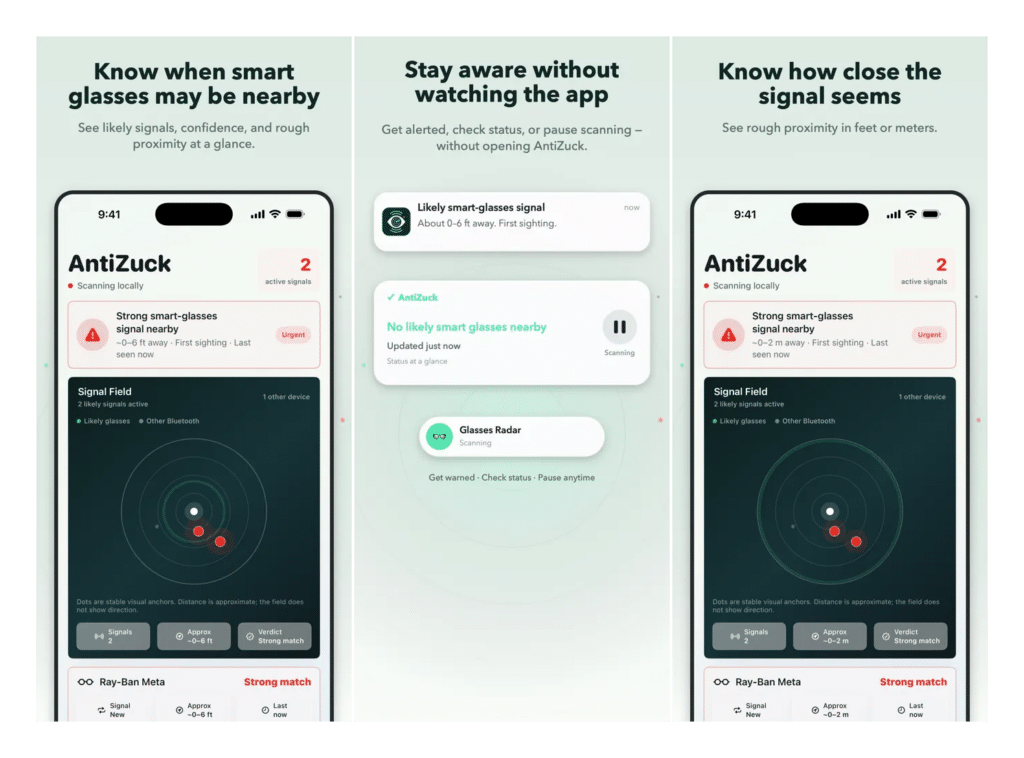
Antizuck is the app that pushed this category into the mainstream, briefly landing among the App Store’s top paid utilities after launch. Built by developer Albert Pariente Cohen, it does the same core job as Nearby Glasses, Bluetooth scanning for Ray-Ban Meta, Snap Spectacles, Amazon Echo Frames, and ReyNeo devices, but wraps it in a more built-out product.
It shows a live signal field with confidence scores instead of a flat yes or no, keeps a sighting history with distance estimates, and adds a lock screen widget, Control Center toggle, and Live Activity support. You can label repeat sightings and snooze alerts for an hour or the rest of the evening. It’s a one-time $4.99 purchase with no subscription, and it holds a 4.8-star rating from 90 reviews.
The catch is platform: it’s iPhone, Mac, and Apple Vision Pro only, with no Android version. It’s also, by its own description, “best-effort” detection dependent on what nearby devices choose to advertise.
3. Nearby Lens: Glasses Detector
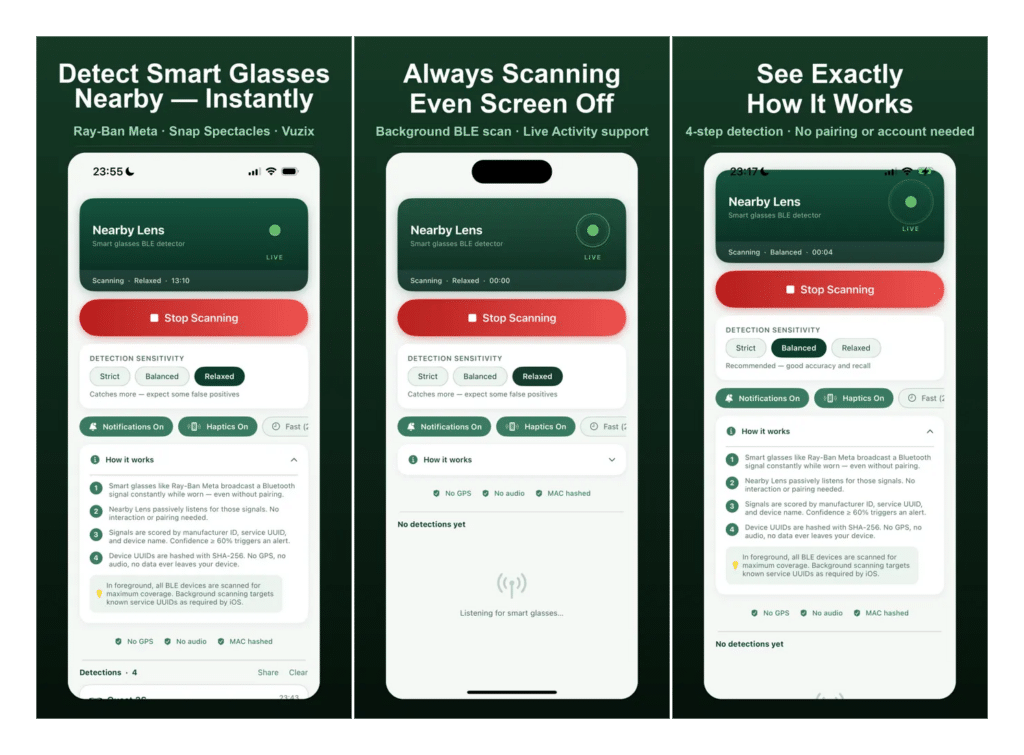
Built by developer Rexhino Kovaci under the MODEX label, Nearby Lens covers more hardware than most competitors, flagging Ray-Ban Meta, Snap Spectacles, Vuzix, XREAL/Nreal Air, Rokid, RayNeo, and Bose Frames by their BLE signatures. Instead of a binary alert, it buckets detections into Immediate, Near, or Far based on signal strength, and it runs entirely offline with no internet connection required.
On iPhone, it adds Dynamic Island and Live Activity support plus Siri Shortcuts, and costs a flat $1.99. The Android version has the same detection engine but is free, an odd but real pricing split between the two stores worth knowing before you pick a platform.
Its weak point is review volume: strong feature set on paper, but both store listings are still light on ratings, so its real-world reliability across devices isn’t as battle-tested as the other picks here.
4. Hidden Camera Detector – Peek
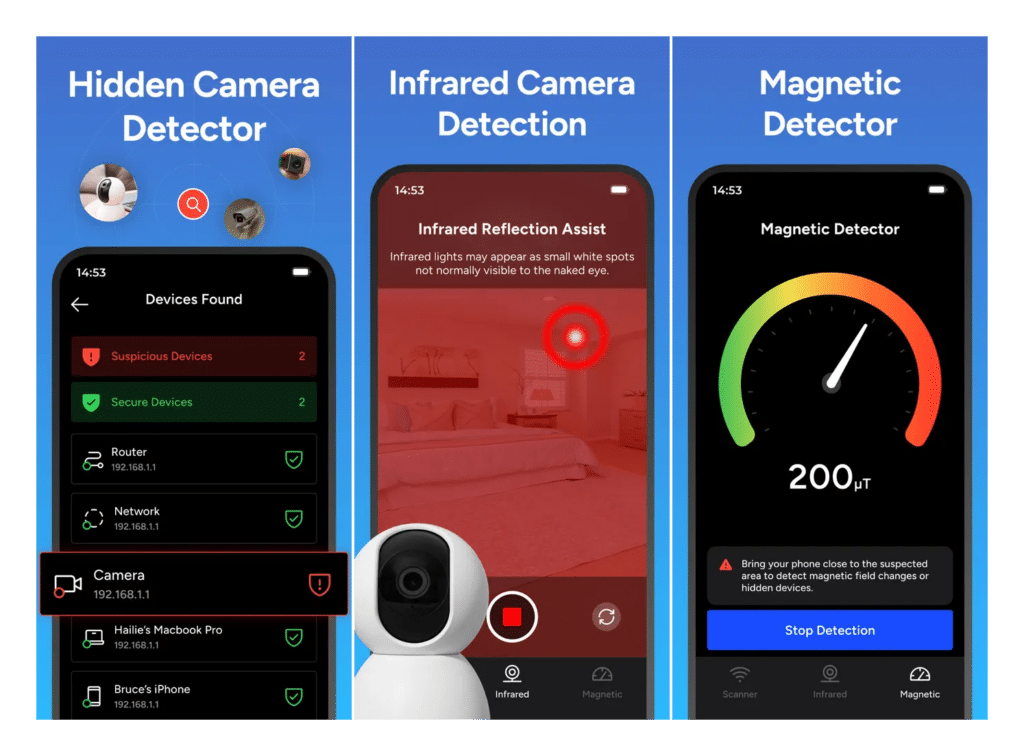
Peek takes the other approach entirely. Instead of listening for Bluetooth, it uses your phone’s camera and an AI model to spot the reflective glint of a lens when you point your phone at someone or something, backed by infrared and Wi-Fi network scanning for stationary devices.
That means it catches a camera in glasses (or anywhere else) even if Bluetooth is switched off, which every BLE-based app in this list would miss entirely.
It’s a well-established app, 4.4 stars from over 16,000 ratings on iOS and the same score across more than 5,600 Android reviews, with 100,000-plus Android installs. The tradeoff is aggressive monetization: the free tier blurs scan results until you subscribe, and pricing runs from $8.99 a week up to a $59.99 lifetime unlock.
Android’s data safety disclosure also notes the app shares device identifiers with third parties and doesn’t let you delete that data. Worth having for the different detection method, but read the permissions before you commit to a plan.
5. Detectify – Devices Detector
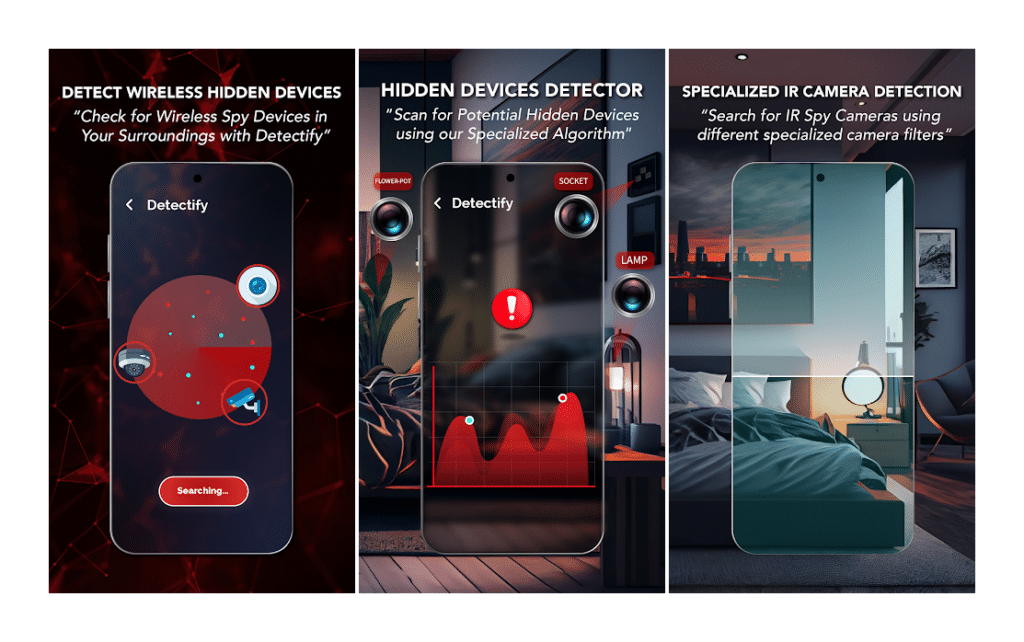
Detectify is the broadest tool on this list and the most downloaded, with over a million installs and a 4.4-star rating across more than 8,000 reviews. Built by WonderTech Studio, it combines three detection methods in one app: a magnetic sensor mode for wired hidden cameras and trackers, an infrared camera mode for lenses in low light, and a Bluetooth and Wi-Fi scanner that picks up any nearby BLE device, smart glasses included, alongside microphones and other spy electronics.
That breadth is the appeal if you want one app that covers more than just glasses. It’s free with ads, and the tradeoff is precision: because it’s built for general spy-device detection rather than smart glasses specifically, its Bluetooth results won’t label a device “Ray-Ban Meta” the way a purpose-built scanner does, and it’s Android only, with no iPhone version available.
Final Thoughts
If you want the simplest, most transparent option, Nearby Glasses (Original) is the one to start with, it’s free, open source, and asks nothing of your data. If you’re on iPhone and want a more capable tool with history and widgets, Antizuck is worth the one-time $4.99. Nearby Lens earns its place if the person you’re worried about might be wearing a brand beyond Ray-Ban Meta. Peek and Detectify both step outside pure Bluetooth scanning, useful the moment you suspect Bluetooth is turned off or you want to check for other hidden devices at the same time.
None of these apps read minds or see through walls. They flag a signal or a lens, and it’s on you to judge the context. Pick based on what you’re actually trying to catch, not which app has the flashiest screenshots.
For more on locking down what you share day to day, see our breakdown of the best free VPN apps for iPhone and Android.