
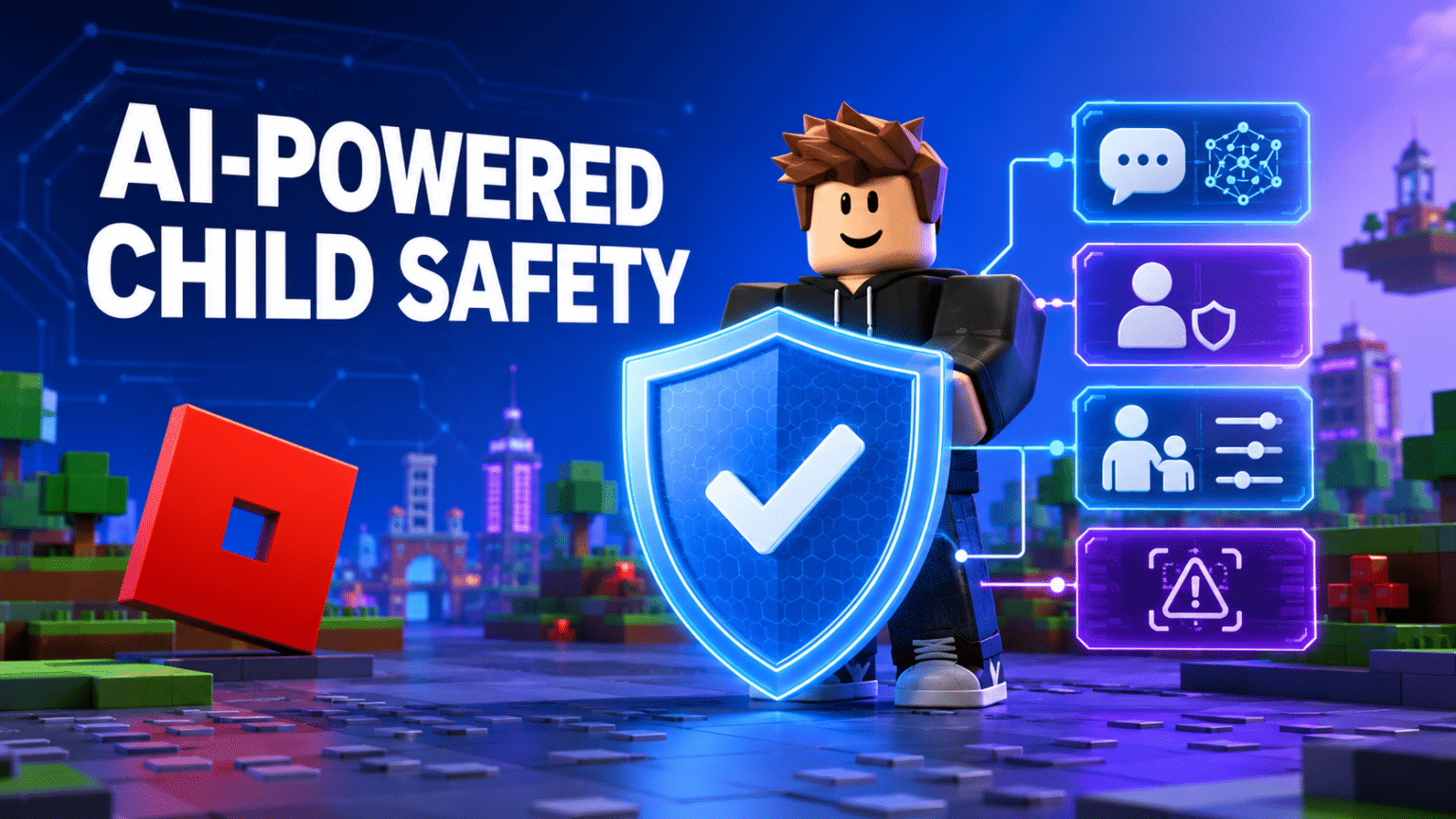
Roblox shared three updated AI safety models on August 19, 2026, contributing them to the ROOST (Robust Open Online Safety Tools) Model Community alongside a new evaluation dataset. The update lands as the platform reports 123 million daily active users in Q2 2026, with nearly 75% of age-checked accounts belonging to users under 18.
If you’re wondering whether Roblox is actually safe for your kids, this announcement is the clearest answer yet: Roblox is leaning harder on automated detection because human moderation alone can’t keep pace with that scale.
The timing isn’t a coincidence. Roblox has settled or is fighting child safety lawsuits from at least six states this year, including a $12.2 million settlement with Alabama in April and active suits from Nebraska, Arkansas, Ohio, and Louisiana. Regulators want proof Roblox can catch predators before they reach a child, not just after a parent files a complaint. The new models, and the data Roblox published alongside them, are the company’s attempt to make that case in public.
Here’s what each tool actually does, why the lawsuits matter for reading these numbers correctly, and which settings you can change today.
What Roblox Changed on August 19
Naren Koneru, Roblox’s Vice President of Trust and Safety Engineering, published the update naming three models: PII Classifier v2.0, Roblox Sentinel v2, and Voice Safety Classifier v3. None of these are brand new. Sentinel has run in production since late 2024, and Roblox open-sourced it in August 2025. What changed is accuracy, language coverage, and how much detection work each model can now do before a human reviewer steps in.
Roblox joined ROOST as a founding member in early 2025, alongside Google and OpenAI. Publishing these models openly lets other platforms, including ones with far smaller trust and safety budgets, use the same detection code instead of building it from scratch.
The 4 Safety Systems, Explained
1. PII Classifier v2.0
- What it does: Flags messages where a user shares or asks for personal contact information: phone numbers, emails, social handles, or usernames on other apps.
- How it works: Reads conversation context instead of scoring one message at a time, so it catches a slow, multi-message attempt to move a child off Roblox.
- Key numbers: F1 accuracy rose from 63.41 to 90.52. Language support expanded from 17 to 189.
2. Roblox Sentinel v2
- What it does: Looks for early conversational patterns that resemble grooming, before an explicit policy violation happens.
- How it works: Compares chat behavior against two reference sets, one built from users with clean histories, one from confirmed endangerment cases, then flags accounts whose patterns skew toward the second group for human review.
- Key numbers: Detection accuracy (ROC-AUC) rose from 0.894 to 0.996. Nearly 70% of child-endangerment cases Roblox identified in the 12 months ending August 7, 2026, came through Sentinel’s early detection rather than a user report.
3. Voice Safety Classifier v3
- What it does: Screens real-time voice chat for policy violations across eight categories and can trigger an automatic five-minute voice suspension.
- How it works: A larger model (320 million parameters, up from 94.6 million) trained on more voice data, covering 30 languages.
- Key numbers: Catches 61% of violations at a 1% false-positive rate. Downloaded more than 72,000 times since Roblox open-sourced it in 2024.
4. Facial Age Estimation
- What it does: Estimates a user’s age from a selfie to unlock age-appropriate chat and social features, instead of relying on a typed birthdate.
- How it works: Built on Persona’s facial age technology, certified under the UK’s Age Check Certification Scheme at Level 3, with a mean absolute error of 1.4 years for users under 18. Roblox says images are deleted once processed and never sold.
- Key numbers: Age-based chat tiers now govern who can contact whom. A 12-year-old can chat with users 15 and under; users 16 and older cannot initiate contact with younger accounts.
Why This is Happening Now
Roblox isn’t rolling out safety tools in a vacuum. In April 2026, Alabama Attorney General Steve Marshall announced a $12.2 million settlement with Roblox over child safety failures. South Dakota reached a separate $10 million settlement in July. Nebraska, Arkansas, Louisiana, and Ohio have filed or moved to lead active lawsuits, several citing cases where predators contacted children on Roblox, then moved the conversation to apps with fewer protections, including a Nebraska case where a man contacted victims on Roblox and continued the abuse on Snapchat.
That platform-hopping pattern is exactly what the upgraded PII Classifier targets. Detecting an attempt to move a conversation off Roblox matters more than moderating what happens inside it, since Roblox loses all oversight the moment a child clicks a link to another app.
Notably, Roblox’s own newsroom post frames the release as “a shared responsibility” across the industry rather than a one-company fix, a signal aimed as much at regulators and rival platforms as at parents.
What Parents Should Actually Do?
None of these systems replace parental settings.
A few concrete steps make more difference than any single AI model:
- Set the account age tier correctly. Roblox groups accounts into age-based experiences (Roblox Kids for ages 5 to 8, Roblox Select for ages 9 to 15), and each tier restricts chat and content differently. An adult-configured account defeats every downstream protection.
- Complete age verification rather than skip it. It’s optional on Roblox, but skipping it drops a child into the least-restricted chat tier by default.
- Review who’s on your child’s trusted connections list. Trusted connections bypass some chat filters, so the list should only include people your child actually knows offline.
- Treat a request to “talk somewhere else” as a red flag, not a normal ask. Every AI model above exists because predators already know this move works.
- Check account status periodically for moderation flags or restrictions your child hasn’t mentioned.
Final Thoughts
Roblox’s models are getting measurably more accurate, and open-sourcing them gives smaller platforms a shortcut to similar protection. Still, independent researchers have found harmful chats that slip past every layer described here, and no detection model catches everything before a human does. The state lawsuits pushing Roblox toward transparency aren’t resolved, and the settlements so far cover past conduct, not a guarantee about what comes next.
Sentinel is an AI system that scans chat patterns for early signs of grooming or child endangerment, flagging suspicious accounts for human review before an explicit violation occurs. It has run in production since late 2024.
189, up from 17 in the previous version. Roblox says the expansion lets the model catch information-solicitation attempts across far more markets than before.
No. Roblox lists it as optional, but skipping it restricts chat and social features for accounts age 13 and up, and defaults the account to more restrictive settings.
Not directly. Roblox’s tools only see activity on Roblox itself. The PII Classifier is designed to catch the handoff attempt before it happens, but once a conversation moves to Snapchat, Discord, or another platform, Roblox loses visibility entirely.
No. Arkansas’s 2026 lawsuit names both Roblox and Discord, and other states are examining how both platforms handle youth chat and age verification.